
Last updated September 20, 2026
Full 25-point door and opener safety check with every visit - springs, cables, rollers, tracks, and your LiftMaster or Chamberlain opener included
You get a price before we start. It does not change when the truck arrives.
 Before
 After
After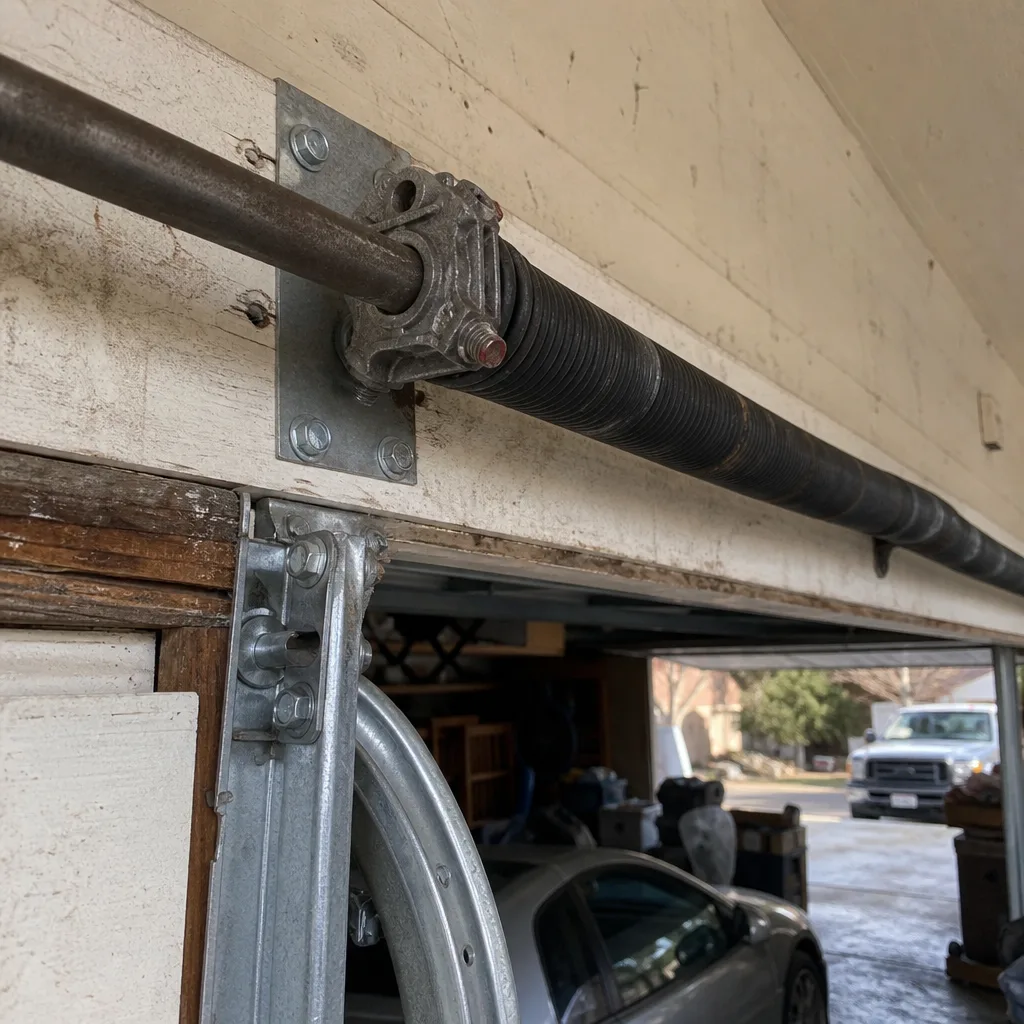 Before
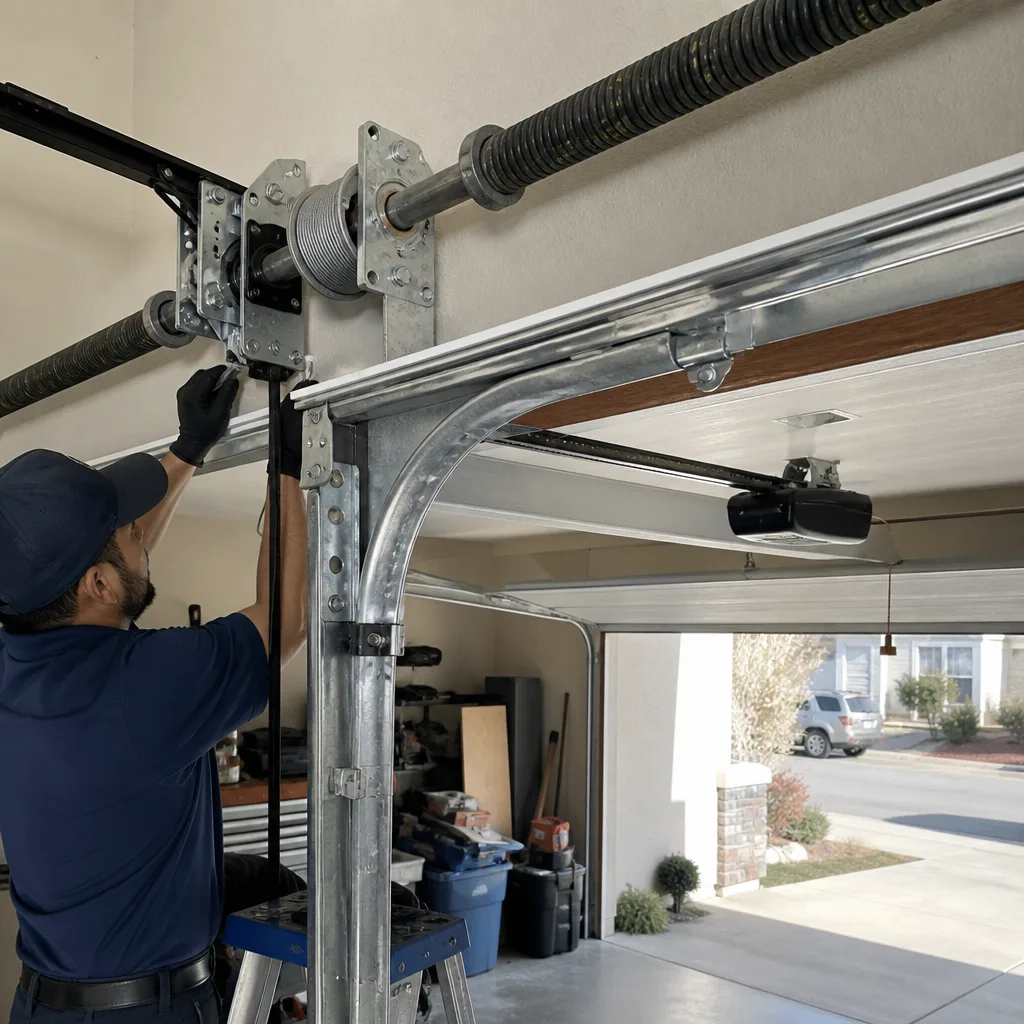 After
After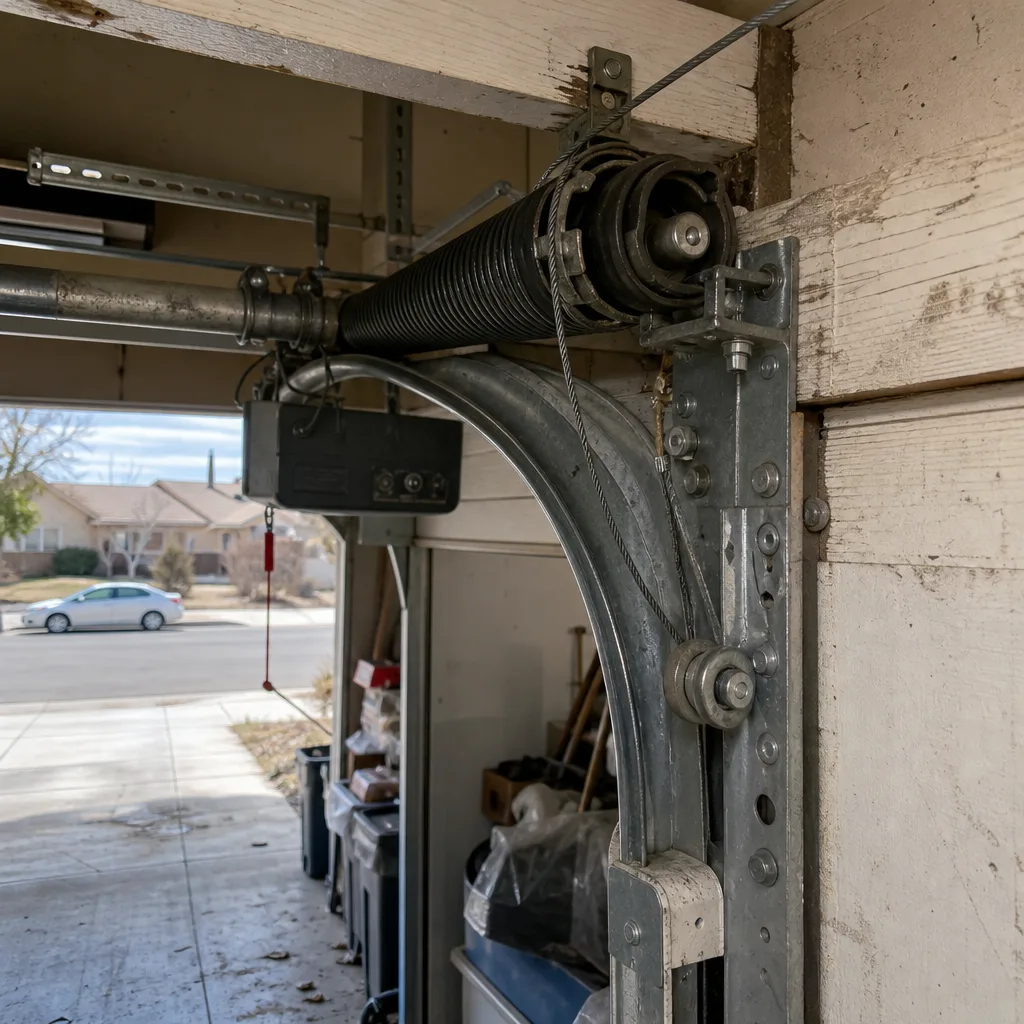 Before
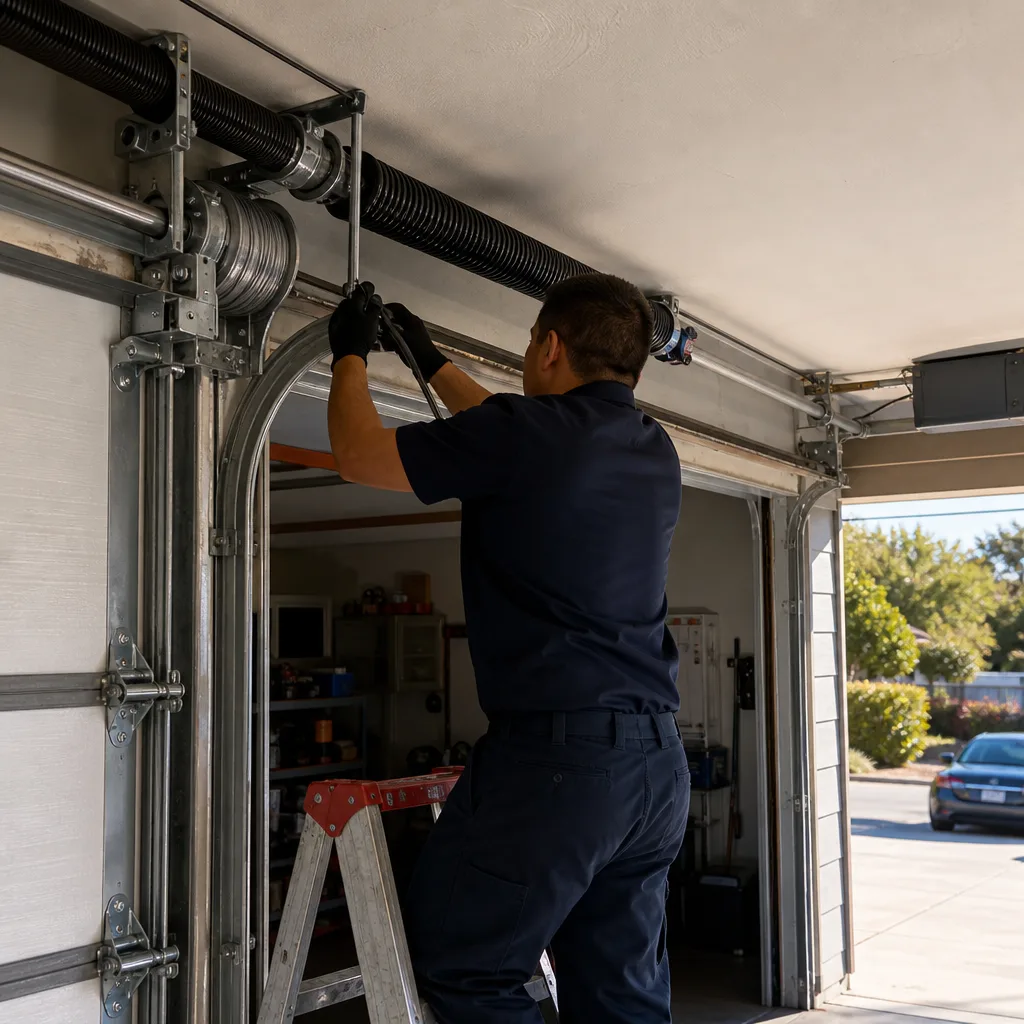 After
AfterDIY vs Professional Garage Door: The Palmdale Homeowner's Decision Guide
A torsion spring stores roughly 100 foot-pounds of torque when fully wound. That is enough stored energy to break a forearm or remove fingers if it releases into your hand. Yet most DIY garage door articles never lead with that sentence. This guide does, because in Palmdale the decision to fix a garage door yourself shouldn't start with "am I handy enough?" It should start with one question: which component am I touching, and what happens if I get it wrong? By the end of this guide, you'll know exactly where the safety line sits, what a DIY repair actually costs in parts and tools, and which jobs California law permits you to do on your own home.
Quick Answer
DIY garage door work is reasonable and safe for a specific set of components: rollers, hinges, bottom seals, lubricant, and minor track alignment. Professional service is non-negotiable for torsion springs, lift cables, and header bracket bolts because those components are under stored tension and release energy without warning. In Palmdale, homeowners may legally repair their own garage door without a contractor license under California's owner-occupant exemption, but liability for spring-related injuries falls entirely on you the moment you insert a winding bar.
Table of Contents
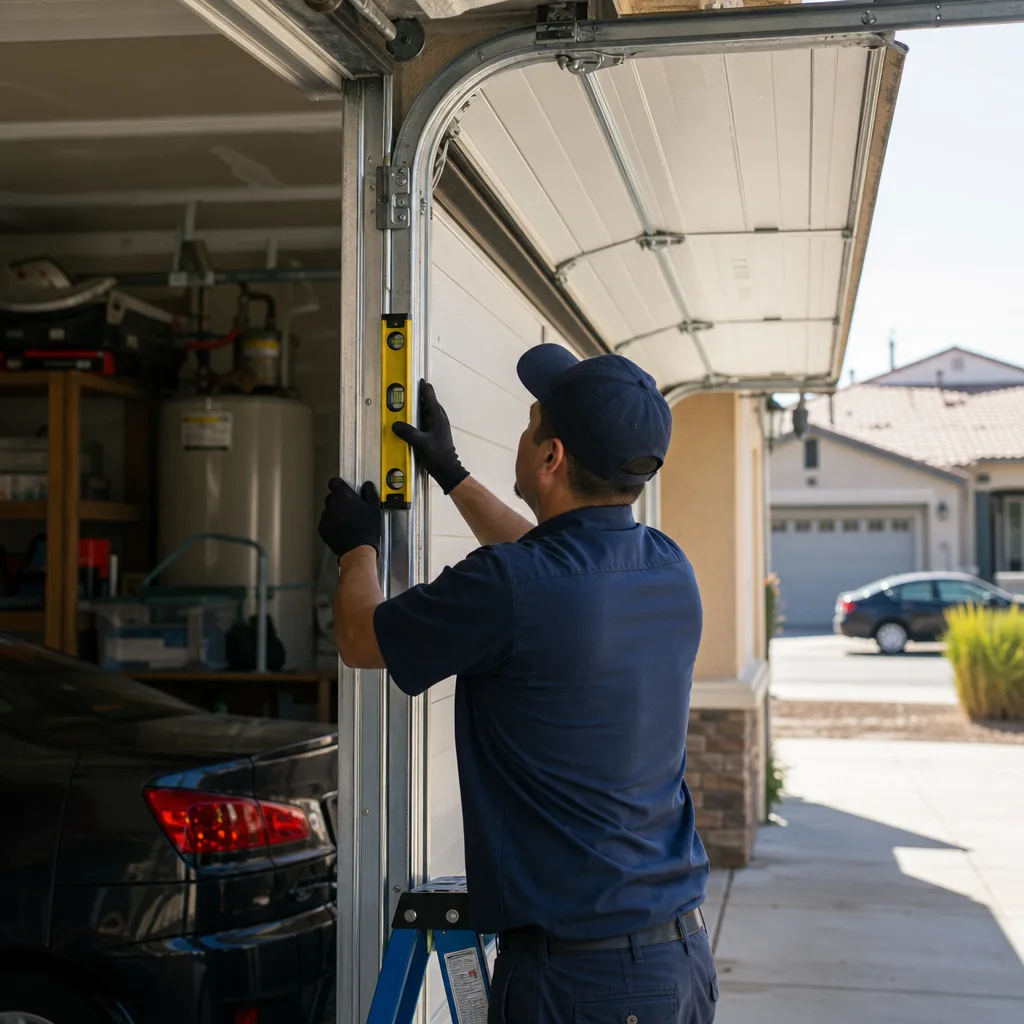
- The Safety Line: Which Components Store Energy
- What a Competent Homeowner Can Safely Do
- What Requires Professional Tooling and Liability
- The Real Math: DIY Parts and Tool Costs vs a Palmdale Pro
- California Owner-Builder Rules for Garage Doors
- How to Document DIY Work So a Future Technician Can Build on It
- Three Scenarios Where DIY Creates a Bigger Repair Bill
 Before
 After
AfterThe Safety Line: Which Components Store Energy
Here is the line that most DIY guides blur: a garage door has two completely different categories of parts. One category wears and is replaceable with hand tools. The other category stores mechanical energy and can injure you without warning, even when the door is closed and appears static.
Category one includes nylon rollers, steel hinges, bottom weather seals, track bolts, and lubricant. These parts are accessible, visible, and safe to handle when the door is in the fully open position with the opener disconnected. Category two includes torsion springs, extension springs, lift cables, and the bolts anchoring the spring header bracket to the wall. All of these carry tension or hold a tensioned assembly in place. Remove the wrong bolt and the bracket becomes a projectile. Cut the wrong cable and the spring unwinds the remaining turns into the nearest hand.
In Palmdale specifically, the high-desert temperature swings from below freezing in winter nights to above 105°F in August accelerate metal fatigue. Steel torsion springs rated for 10,000 cycles fail earlier in Palmdale than in coastal climates because the diurnal expansion and contraction stresses the coil at the set screw point. We see springs in Palmdale neighborhoods like Rancho Vista, West Palmdale, and Anaverde break at 7 to 9 years rather than the 10 to 12 you will read about in manufacturer literature written for temperate climates. That compression matters when you are deciding whether a suspicious-looking spring has life left in it.
The actionable version: if the part you plan to touch is under the words "tension," "torsion," "cable," or "header bracket," stop. If it is a roller, hinge, seal, or track bolt, you are in reasonable territory.
What a Competent Homeowner Can Safely Do
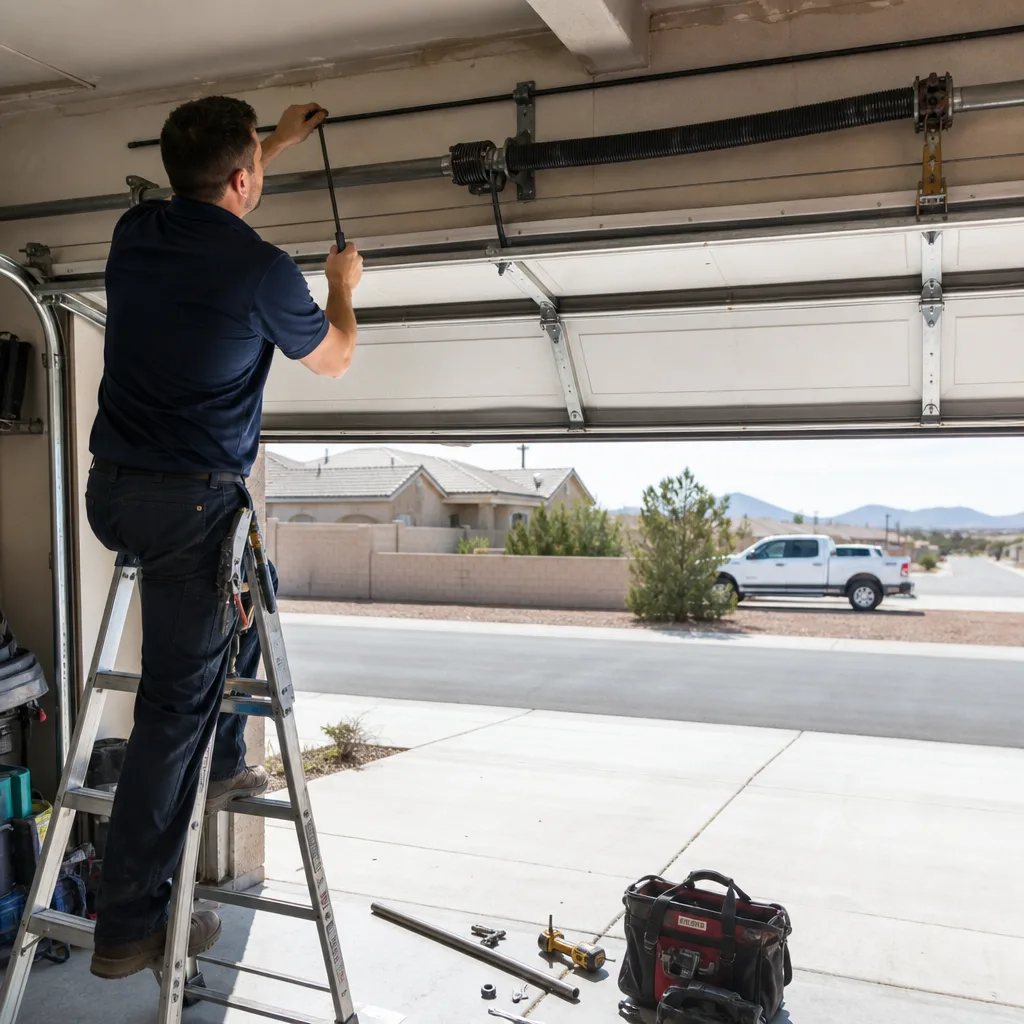
This section assumes you own a socket set, a step ladder, and the patience to read a parts diagram before unbolting anything. None of these jobs require specialty tooling, and all of them are reversible if you take photos first.
Roller replacement. Nylon rollers wear out on schedule. If your door sounds like it's grinding gravel, the rollers are the likely culprit. Replacement requires removing the bottom bracket (safe, because the cable is anchored there but you are not removing the cable itself), swapping each roller one at a time while the door remains in the track, and reinstalling. A set of ten nylon rollers costs $18 to $35 at any Palmdale hardware store. The time commitment is about 90 minutes.
Bottom seal replacement. The rubber strip at the door's bottom edge hardens and cracks in the Palmdale sun. A U-shaped seal slides out of its aluminum retainer channel once you unscrew the end cap. Replacement seals run $15 to $30 depending on door width. This is a 30-minute job with a utility knife and a screwdriver.
Hinge tightening and replacement. Door panels connect with steel hinges numbered 1 through 4 based on position. A loose hinge makes the door bow or bind. Tightening is free. Replacing a bent hinge costs $8 to $15 and requires two bolts.
Lubrication. White lithium grease on the torsion spring, hinges, and bearings once a year extends component life and quiets operation. A $6 can lasts two years. This is the single highest-value maintenance task for Palmdale homeowners because it also lets you inspect the spring while you are there.
Minor track bolt tightening. Vertical tracks bolt to the wall with lag screws that vibrate loose over years of opener cycles. Tightening them with a socket wrench is safe provided you do not adjust anything. If the track is bent, stop and call a professional because track geometry is a safety parameter.
One caution: even these benign tasks become dangerous if the door is not in the fully open position with the opener's emergency release pulled so the door cannot move. Gravity is its own force, and a descending 150-pound door will hurt regardless of whether a spring is involved.
What Requires Professional Tooling and Liability
This is the short list that matters. If the part you need to touch appears here, the DIY question is settled.
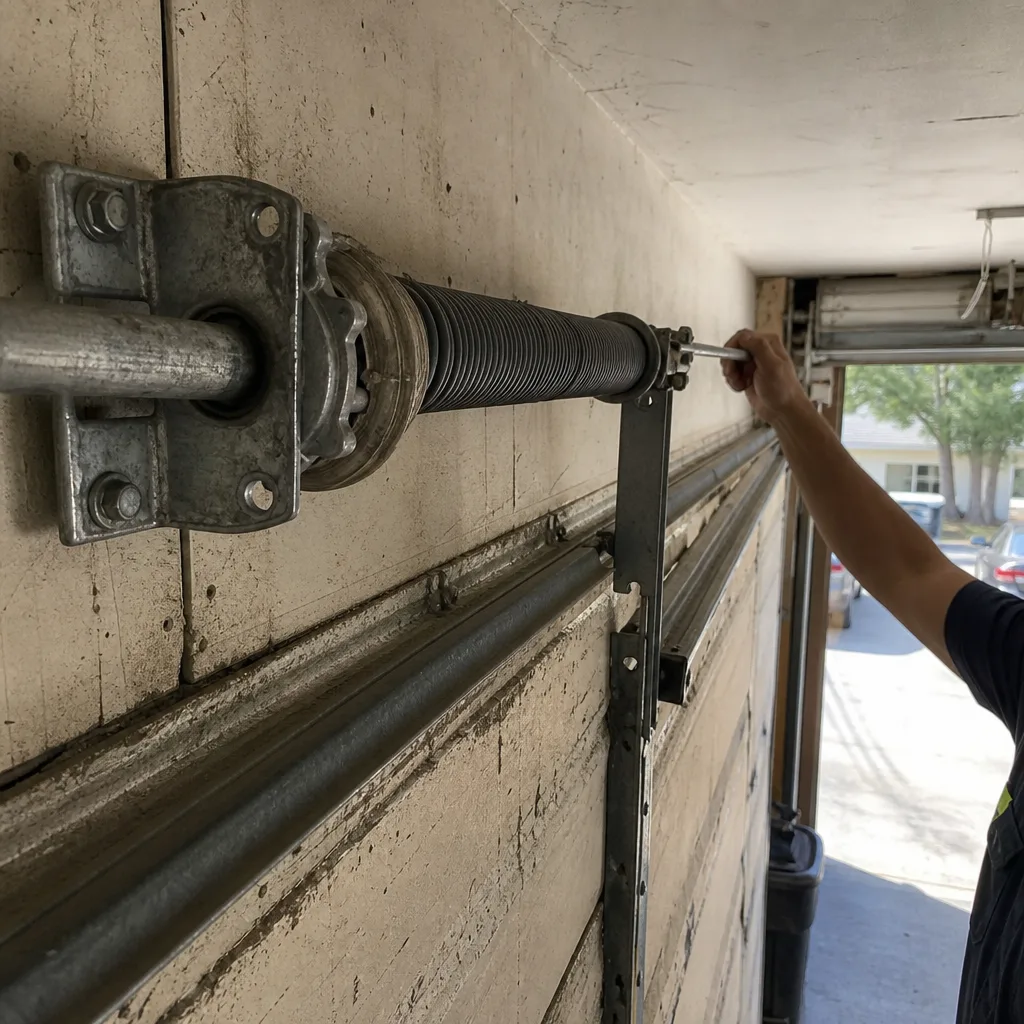
Torsion springs. The spring mounted above the closed door on a steel tube is wound with a specific number of quarter turns, normally 7 to 9 per side depending on door height and weight. You cannot see stored torque, which is why it surprises people every year. Winding and unwinding requires two steel winding bars inserted into the spring cone, a process that puts both hands and your face in the exact plane where a bar kicks out if the cone set screws strip. We use a phrase with our Palmdale customers: the spring fails toward the person winding it. No roller replacement carries that risk.
Lift cables. Each side of the door has a cable that runs from the bottom bracket up to the drum. When the door is closed, these cables carry the spring's tension. When the door is open, they slack. If a cable snaps while you are working below it, the loose cable whips. Replacing a cable requires attaching it under tension with the door secured, a process that goes wrong for first-timers in predictable ways.
Header bracket and its lag bolts. The bracket that holds the torsion tube to the wall above the door carries the full torque load every cycle. The lag bolts are under shear stress. Removing one without transferring the load correctly is how we see garage wall headers torn out. This is a structural repair, not a parts swap.
Extension springs on older doors. Palmdale has thousands of homes built in the 1980s and 1990s with extension spring systems running alongside the horizontal tracks. These springs stretch under load, and when they break, the broken end travels. If you find a door with springs on the sides rather than above, treat them with the same caution as torsion springs.
The professional tooling distinction is not about gatekeeping. It is about the fact that a winding bar set costs $35 and knowing where to stand is not written on the packaging. Liability sits with whoever turns the bar. If that is you, your homeowner insurance may not cover the injury, and your medical deductible will exceed the cost of the entire professional repair.
The Real Math: DIY Parts and Tool Costs vs a Palmdale Pro
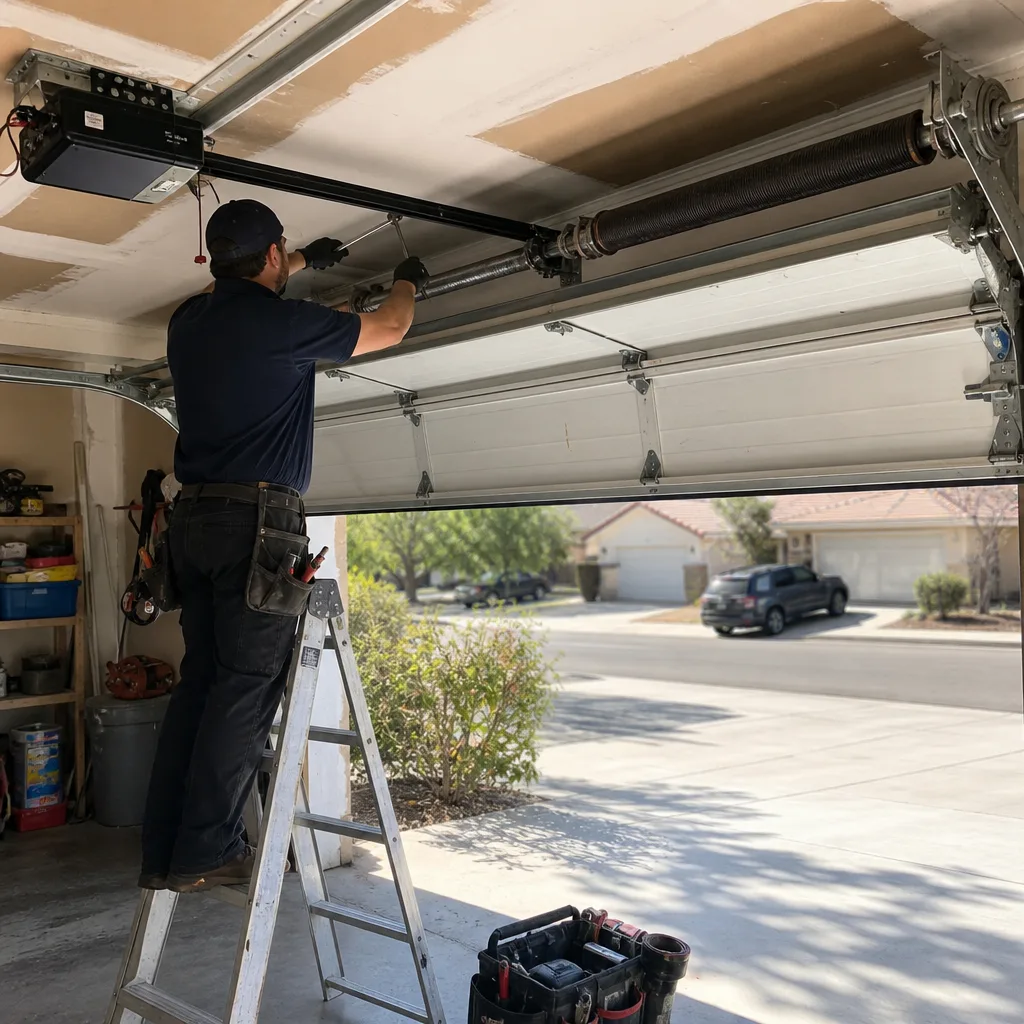
Here is what the economics actually look like in Palmdale, using 2025 pricing from local suppliers. For a deeper breakdown, read our Garage Door Cost Breakdown: The Palmdale Homeowner’s Reference for 2026. These numbers assume you already own basic hand tools. If you are buying everything fresh, add $80 to $150 for a socket set and step ladder.
| Repair | DIY Parts Cost | DIY Time | Typical Palmdale Pro Range | Risk Level |
|---|---|---|---|---|
| Roller replacement (set of 10) | $18-$35 | 1.5 hours | $140-$220 | Low |
| Bottom seal replacement | $15-$30 | 30 minutes | $90-$160 | Low |
| Hinge replacement (single) | $8-$15 | 20 minutes | $80-$130 | Low |
| Lubrication | $6 | 15 minutes | $75-$120 (with inspection) | None |
| Cable replacement (pair) | $25-$40 parts; risk prohibitive | Not recommended | $180-$280 | High |
| Torsion spring replacement (pair) | $60-$110 parts; requires winding bars and training | Not recommended | $280-$480 | Severe |
| Opener logic board replacement | $60-$150 (model-specific) | 1 hour | $160-$300 | Low to moderate |
The conclusion from the numbers: DIY saves real money on rollers, seals, hinges, and routine lubrication. The savings disappear entirely on cable and spring work because one mistake converts a $300 professional repair into a $1,500 emergency call, and that assumes the mistake damages only the door and not your hand.
One more variable specific to Palmdale: supply. Home Depot and Lowe's in Palmdale stock common springs and rollers, but when supply is thin, marked-up parts sit on Amazon with ambiguous sizing. A wrong-size torsion spring installed by a homeowner is worse than no repair at all because it under- or over-balances the door and stresses the opener.
California Owner-Builder Rules for Garage Doors
California Business and Professions Code section 7048 permits a homeowner to perform work on their own primary residence without a contractor license, provided the work is not for sale or rental within a year of completion. For the full regulatory picture, see Garage Door Permits, Codes & Inspections in CA: What You Need to Know. Garage door repair and installation fall under this exemption when you live in the home and do the work yourself. You may also hire unlicensed day labor as long as you direct and supervise the work, though that carries its own risk exposure on your homeowners policy.
What the exemption does not do:
- It does not waive local building permit requirements where they exist. In Palmdale, a full garage door replacement on an existing opening does not typically require a building permit, but modifying the opening size or adding a new opening goes through the City of Palmdale Building and Safety division. Check with a call before cutting framing.
- It does not transfer product warranty obligations. A Clopay or Amarr door installed by a homeowner carries the manufacturer's parts warranty but not an installation workmanship warranty. If the door tracks were installed out of square, the manufacturer will deny the claim regardless of how the part itself performs.
- It does not protect you from liability if your work fails and damages someone else's property. If your DIY spring repair launches a winding bar through the neighbor's window, that is a claim against your homeowner policy, subject to your deductible.
The California rule is genuinely permissive. It is not a safety endorsement. Legal permission and physical safety are separate questions, and the state's interest ends at licensing.
How to Document DIY Work So a Future Technician Can Build on It
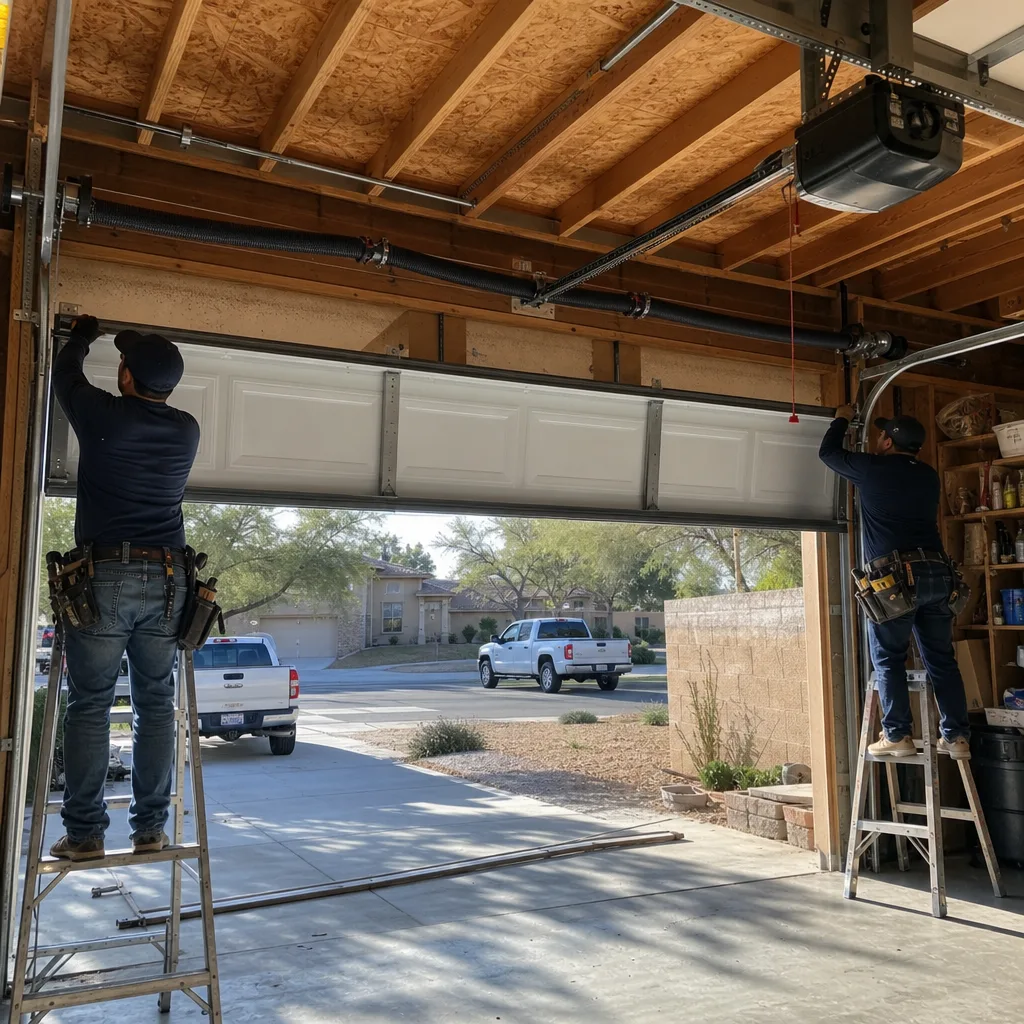
Here is what a professional technician's documentation looks like, and you should produce the same record if you DIY. The purpose is not to impress anyone. It is so that when something fails in eighteen months, the technician can diagnose in minutes instead of guessing at what was touched.
- Photograph the area before you begin. Wide shot of the door from both sides, the spring line above the door, the track on each side, and the bottom brackets. These four photos are your baseline.
- Photograph the part as you remove it. If a roller is chipped, photograph the chip. If a hinge is bent, photograph the bend. The evidence tells a future technician whether the problem is isolated or systemic.
- Write down the part number and manufacturer. Do not trust memory. A Chamberlain rail and a LiftMaster rail look similar but do not interchange. Write the number printed on the old part before you discard it.
- Photograph the finished work. Same angles as step one. These before-and-after pairs are what a professional would hand you, and they matter if a warranty question comes up.
- Note the date, the part cost, and the source. A simple note in your phone is enough: "2/14/25, replaced two bottom rollers, Clopay nylon 2-inch, $9, Home Depot Palmdale."
This is the same documentation discipline we follow on every visit in Palmdale under The Haven Standard. Clause 4 is why our technician photographs the failed component before quoting a replacement. You receiving that photo record is not a courtesy, it is the paper trail that makes the repair verifiable. Your DIY version of that paper trail is the photos and part numbers above.
Three Scenarios Where DIY Creates a Bigger Repair Bill
These are the three failure patterns we see repeatedly in Palmdale homes where a homeowner attempted a repair before calling us. Each one converts a modest professional bill into a much larger one.
1. Stripped cable drum set screws. The drum at each end of the torsion tube holds the lift cable in a spiral groove. The cable drum is locked to the tube with set screws, and those set screws are what hold the entire spring tension. When a homeowner attempts a cable replacement without first securing the torsion tube, the drum spins, the set screws strip their threads, and the tube is scored. The repair now requires replacing both drums and possibly the tube, at $180 to $320 more than the cable replacement alone would have cost.
2. Over-tensioned spring winding. A homeowner watches a video, buys winding bars, and adds an extra quarter turn because the door felt heavy. That extra turn over-balances the door so it rockets upward when released. The opener's travel limits then slam the door into the opener rail repeatedly, wearing the limit switch and the rail assembly. Correcting this means unwinding and re-winding the spring to specification, plus replacing whatever the unbalanced door damaged. In Palmdale, where Chamberlain and Genie openers dominate residential installs, the limit switch replacement alone is a $120 to $180 part.
3. Misaligned track bolts. A homeowner loosens track bolts to fix a rubbing door, nudges the track to where it looks right, and tightens it. The door runs fine for three weeks, then begins binding at the top of travel. The track was moved 3/16 of an inch out of parallel, and the constant pressure has now bent the track itself. Straightening or replacing track costs $150 to $250, and the original problem, a worn roller, needed a $20 part.
The common thread: the DIY attempt in these scenarios was structurally sound. The problem was not lack of skill. It was lack of the specific measuring and securing steps that a professional performs before touching the part. Those steps are not in the videos.
The Opener: Where DIY Is Genuinely Reasonable
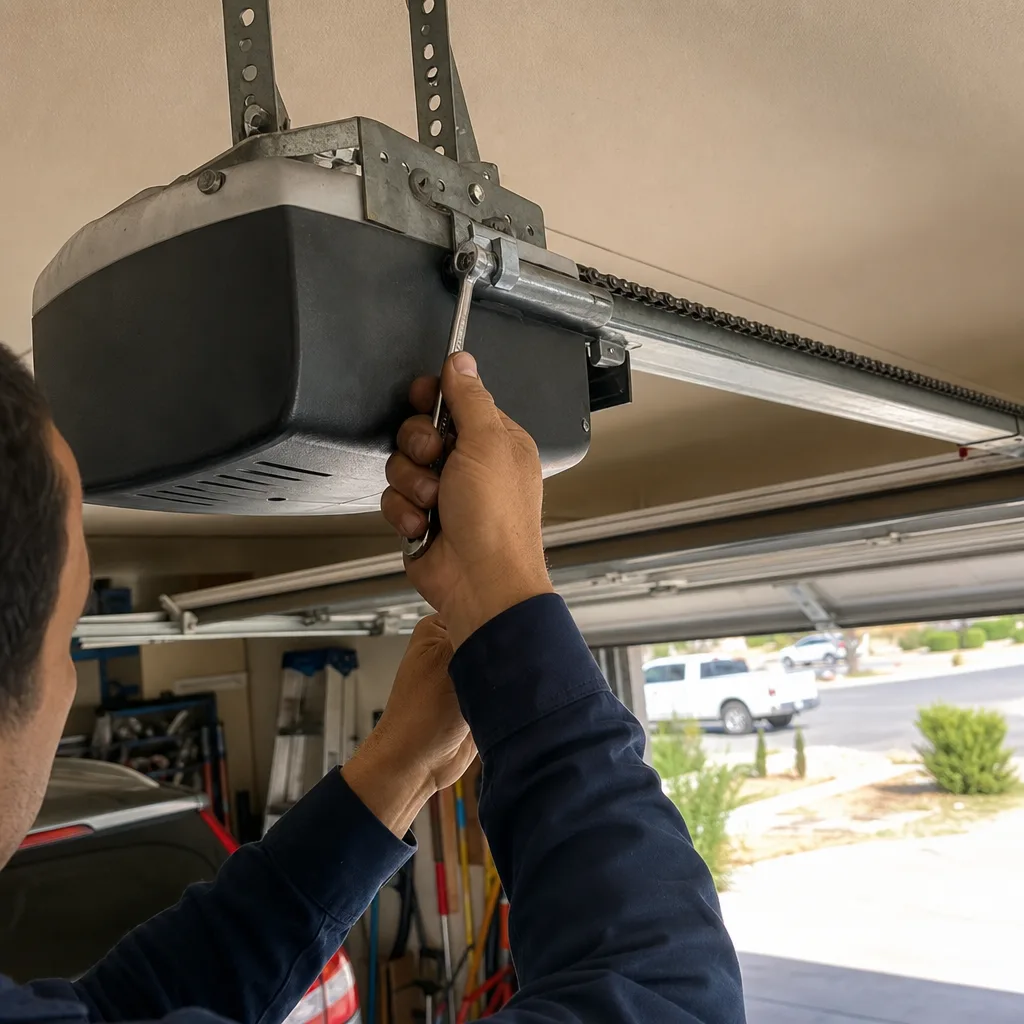
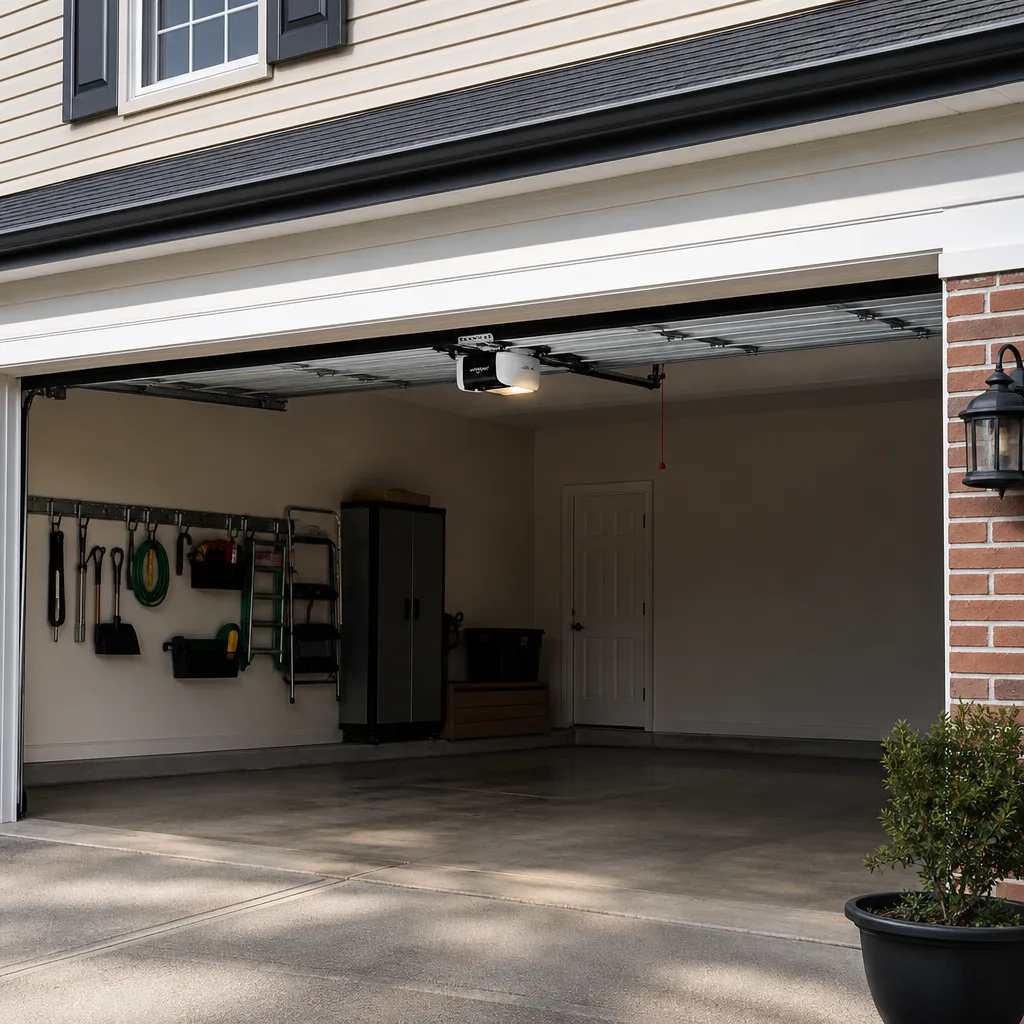
Garage door openers are a different conversation from the door itself. The dangerous stored energy lives in the spring system. The opener is an electrical appliance bolted to the ceiling, and replacing one is within reach of a competent homeowner.
The opener's failure points are diagnosable without specialty tools. A door that opens but will not close points at the safety sensor alignment or the logic board. A door that hums but will not move points at the capacitor or the motor gear. A remote that will not pair points at the receiver or the battery. Each of these has a $20 to $160 fix if you correctly identify the part.
What a professional brings to opener work is diagnosis speed. The technician sees the symptom and checks the three likely culprits in order. A homeowner reading a forum will chase five possibilities across three evenings. In Palmdale, where a non-functional opener means a car stuck in the garage on a 105-degree afternoon, that time difference has real value. We've also seen opener DIY go wrong in a specific way: the homeowner replaces the opener but does not touch the door itself, and the tired spring the old opener had been fighting destroys the new opener's gear inside a year. The opener and the door are a system. If you DIY one without assessing the other, you are buying yourself another repair in 12 months.
Palmdale-Specific Factors That Change the DIY Calculus
The national DIY advice does not always survive contact with the high desert. Here is what Palmdale specifically does to garage doors and to your decision.
UV degradation. The sun here is punishing on polymer components. Bottom seals and nylon rollers crack and chip faster in Palmdale than in coastal California. This means the DIY maintenance schedule should be more frequent, not less. It also means a "minor" cracked seal is a genuine energy leak because your attached garage is already hot, and gaps let that heat in faster.
Temperature swing fatigue. Springs and metal components expand and contract more here than in stable coastal climates. The failure mode in Palmdale is often sudden spring breakage with no prior noise, because the fatigue accumulates invisibly at the molecular level. A homeowner who inspects their spring once a year is doing exactly the right thing, but even an inspection cannot always predict a spring that is about to break.
Wind loading. Palmdale sits in a wind corridor. A double-wide garage door is a large sail, and sustained winds of 20 to 30 MPH with gusts higher put lateral stress on track bolts, hinges, and support struts. Loose track bolts that are safe to tighten in the first years will eventually need more than tightening. If your door is more than 15 years old and you hear rattling during wind events, the logical move is a professional assessment of the track geometry, not a socket wrench on the bolts.
Housing stock age. Palmdale grew in waves: the 1980s west-side tracts, the 1990s and 2000s Rancho Vista and Anaverde builds, and more recent east-side development. Door types vary by era. 1980s doors use extension springs. 1990s and 2000s doors use torsion springs, often Clopay or Amarr steel doors with Chamberlain openers. Newer builds lean toward Wayne Dalton or custom wood with LiftMaster openers. Knowing which era your home falls into tells you a lot about what you will encounter when you open the panels.
Common Mistakes to Avoid
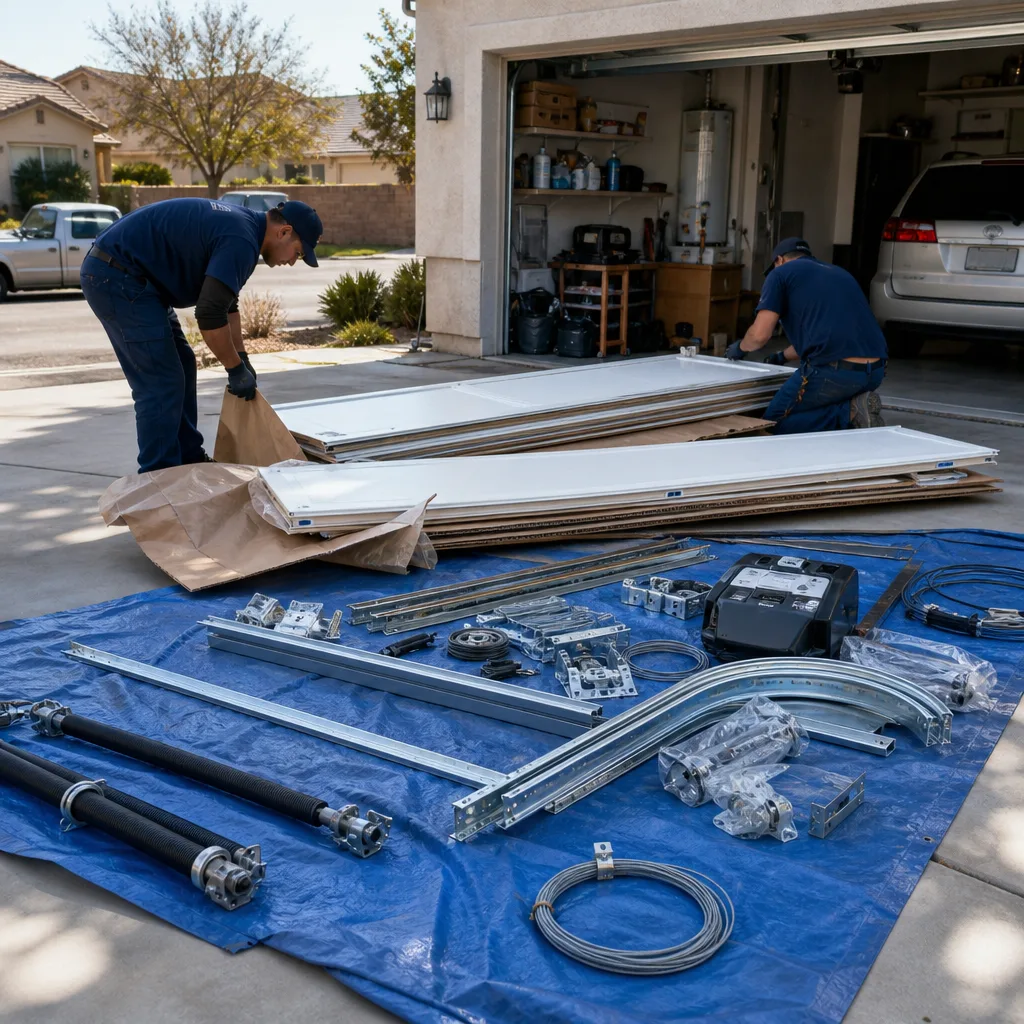
- Treating the spring as a wear item. A roller is a wear item. A spring is an energy storage device. Confusing those categories is the mistake behind most garage door injuries, including in Palmdale where spring failures are common enough that everyone knows someone who had one break.
- Disconnecting the opener without securing the door. Pulling the emergency release while the door is open, then working underneath it, is a gravity problem waiting to happen. Clamp the track or brace the door before doing anything in its path.
- Buying parts before identifying them. A spring's wire diameter, length, and inside diameter all determine its torque rating. Guessing and ordering from an online photo is how we end up called to fix over-tensioned doors in Palmdale's west-side neighborhoods.
- Assuming the opener is the problem when the door is heavy. A door that strains the opener is usually a spring that has lost tension or a track out of alignment. Replacing the opener without fixing the door is the most expensive version of this mistake.
- Skipping the documentation step. Future repairs are faster and cheaper when the technician can see what was touched. In Palmdale we work on doors that have been through three owners, and the ones with no history always cost more to diagnose.
- Ignoring the safe zone. For any door with a torsion spring, the safe place to stand while the door operates is never directly beneath a raised door and never beside the spring cones during operation. These are the two locations where failures send components.
- Assuming DIY always saves money after tools and time. The first DIY repair on a garage door often costs more than a professional call once you buy the tools, the parts, and the second trip to the store for the part you forgot. The savings are real on recurring maintenance, not on first-time specialty repairs.
When to Call a Professional
Call a professional when the part stores energy, when the door no longer moves smoothly and you cannot see the cause, or when the repair list includes more than two components. Call a professional when the door has come off its tracks, when a cable is frayed or snapped, when the spring is visibly broken or showing a gap, or when the door will not stay where you put it. Call a professional when you have already tried a fix and the door now behaves differently than before you touched it, because the interaction between your adjustment and the original problem is now part of the diagnosis. Servo Garage Doors Palmdale offers free estimates throughout Palmdale, and we write the price before any work starts. If you want a second set of eyes before committing to a repair, call (661) 449-2581 and we will walk the door with you. For more guides & resources, visit our blog.
Frequently Asked Questions
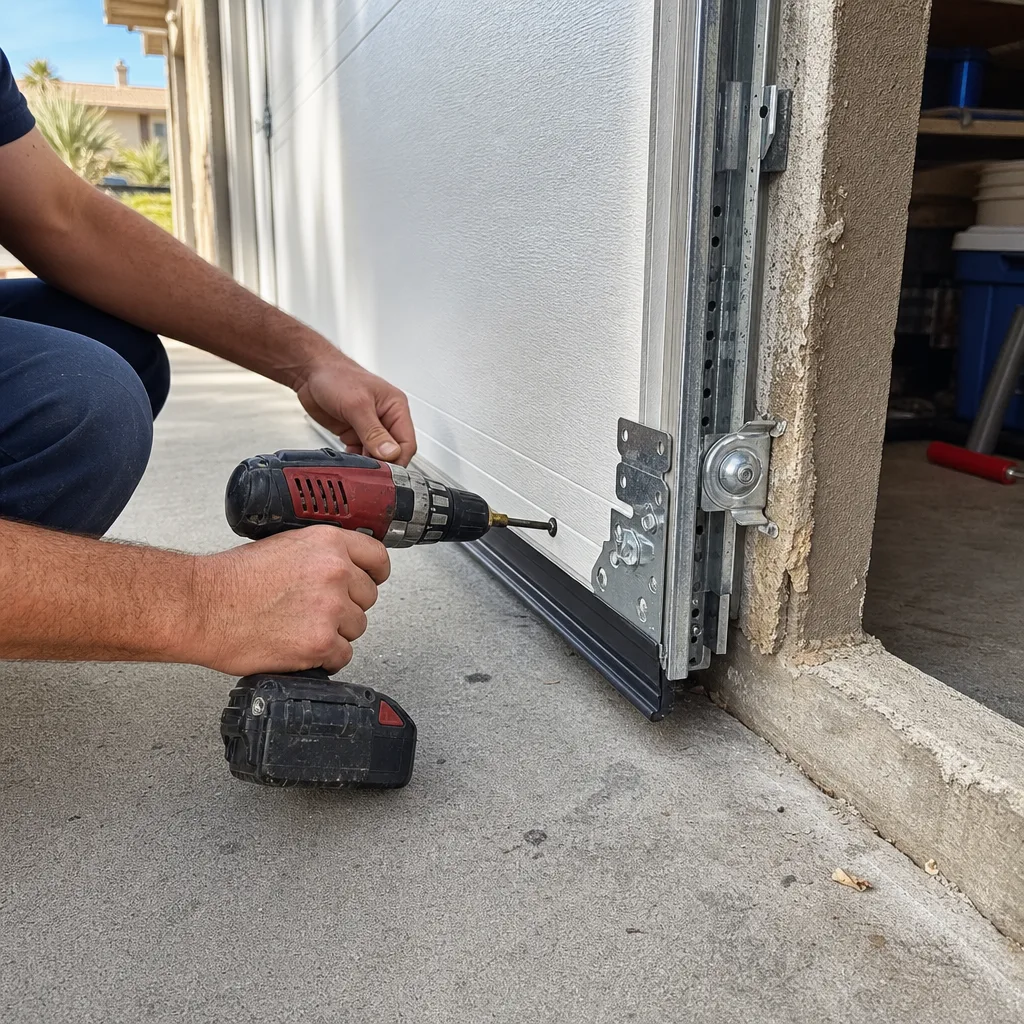
Yes. California's owner-occupant exemption under Business and Professions Code section 7048 allows you to perform repairs on your own primary residence without a contractor license, and garage door work falls under that allowance. A full replacement on an existing opening does not typically need a Palmdale building permit. Structural changes to the opening do. Legal permission and physical safety are separate questions, and the spring does not care about the code section.
In Palmdale, a professional torsion spring replacement for a standard double door typically runs $280 to $480 for both springs, parts and labor included. The price varies with door weight, spring wire diameter, and the spring's cycle rating. A pair of high-cycle springs costs more than economy springs, and in Palmdale's temperature-swing climate, the higher-rated springs are usually the better long-term value. We always quote a flat written price before any work starts.
You can safely replace rollers, hinges, bottom seals, and handle cosmetic track bolt tightening without specialty tools or stored-energy risk. Lubrication is also a homeowner task. The door should be in the fully open position with the opener disengaged and the track clamped for anything you do. We've written out the full list in the Garage Door Repair in Palmdale guide if you want the step-by-step version.
In Palmdale's high-desert climate, torsion springs typically last 7 to 9 years for a standard 10,000-cycle spring on a door that cycles twice a day. The temperature swings accelerate fatigue compared to coastal California. If your door is in that age range and you hear a loud pop followed by a dead door, the spring has failed. The door will not open by opener power in that state because the opener is not designed to lift the full door weight.
A professional repair in Palmdale ranges from $90 to $180 for simple jobs like seal or roller replacement, $180 to $280 for cable work, and $280 to $480 for spring replacement. Every project gets a flat written price and written scope before any work begins under Clause 1 of The Haven Standard. A full Garage Door Installation in Palmdale runs higher because it includes the door, tracks, hardware, and labor as a system.
Replacing a garage door opener is a reasonable DIY job if you are comfortable with basic electrical and structural mounting, and most Chamberlain, Genie, and LiftMaster openers come with installation instructions. The failure point is usually not the installation, it is the diagnosis: many homeowners replace an opener when the real problem is a tired spring or an out-of-alignment door. If your old opener worked fine for years and then suddenly will not lift the door, check the door balance first. Our Garage Door Opener Repair & Installation in Palmdale page covers the diagnostic order we use.
The Bottom Line
The DIY-vs-professional question for garage doors resolves to one line: which side of the stored-energy boundary does the part sit on. Rollers, hinges, seals, and lubricant are on your side. Torsion springs, lift cables, and header brackets are not, and no amount of YouTube confidence changes what 100 foot-pounds of torque does to a forearm. Palmdale's climate accelerates wear, which makes the maintenance jobs more valuable and the spring failures more likely. If you take three things from this guide: know which parts store energy, document every repair with photos and part numbers, and get a written price before any professional work begins. That last one is how we operate at Servo Garage Doors Palmdale home, and it is the standard by which we recommend any contractor be judged. For a free estimate on work you would rather not do yourself, call (661) 449-2581 and a live person will answer.
Written by Marcus Deller, Owner at Servo Garage Doors Palmdale, serving Palmdale since 2015.