
Last updated September 20, 2026
Full 25-point door and opener safety check with every visit - springs, cables, rollers, tracks, and your LiftMaster or Chamberlain opener included
You get a price before we start. It does not change when the truck arrives.
 Before
 After
After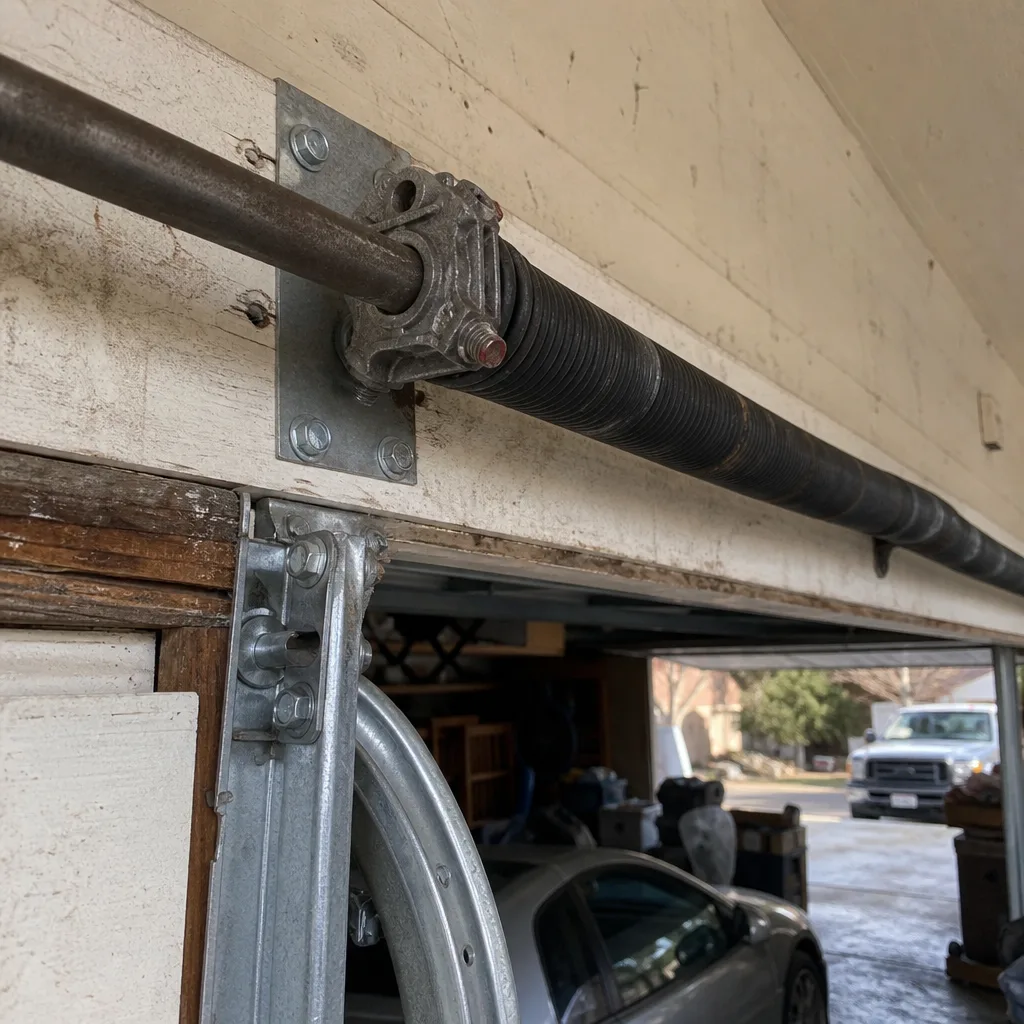 Before
 After
After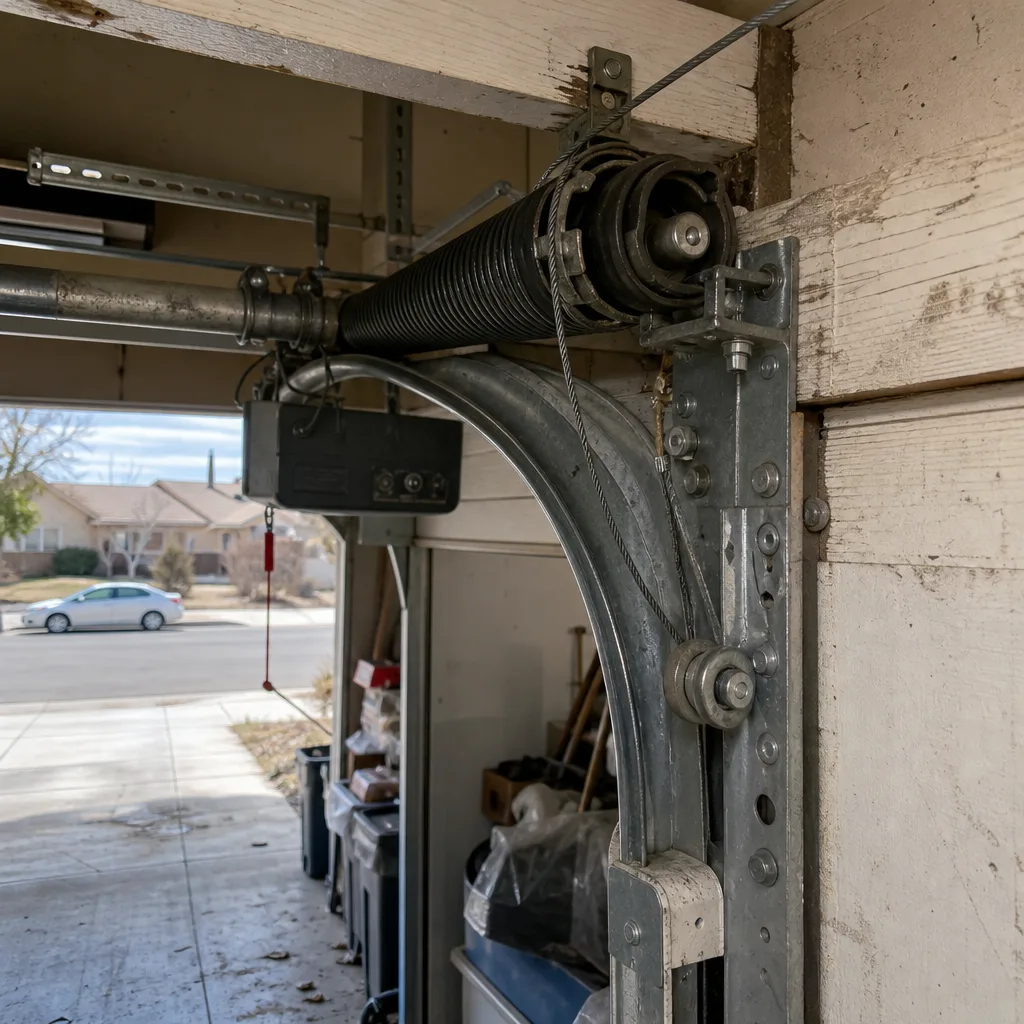 Before
 After
AfterSeasonal Garage Door Care for Palmdale: Year-Round Homeowner’s Guide
Palmdale’s July average high exceeds 100°F, and its January nights drop below freezing. That’s a 100-degree annual swing, and it cycles garage door seals, springs, and circuit boards faster than any coastal California maintenance schedule accounts for. Most seasonal garage door advice you’ll find online-like our Complete Guide to Garage Door in Palmdale-was written for places with four predictable seasons and moderate humidity. Palmdale doesn’t work that way. This guide gives you a maintenance calendar built for the high desert: two service windows, not four, mapped to the Santa Ana wind season and the summer heat spike. You’ll learn what actually fails here, when it fails, and what to check before it becomes a $400 repair.
Quick Answer
Seasonal garage door maintenance in Palmdale should follow two critical service windows each year: late September, before Santa Ana wind season, and early May, before the summer heat spike. The two highest-failure components in the high desert are torsion springs, which lose calibration from thermal expansion, and bottom seals, which degrade roughly twice as fast as manufacturer ratings under Palmdale’s UV intensity. A homeowner can handle visual inspections, lubrication, and seal replacement. Spring tension adjustment and track realignment require a trained technician.
Table of Contents
- Why the Four-Season Model Fails in Palmdale
- The Two-Axis Maintenance Calendar: September and May
- How Summer Heat Affects Torsion Springs: Symptoms Before Failure
- Bottom Seals and Weatherstripping: What the High Desert UV Actually Does
- Cold-Morning Opener Sluggishness: What’s Happening and How to Fix It
- Post-Windstorm Inspection Protocol for Santa Ana Season
- Common Mistakes to Avoid
- When to Call a Professional
- Frequently Asked Questions
- The Bottom Line
 Before
 After
AfterWhy the Four-Season Model Fails in Palmdale
Most garage door maintenance guides are built around a calendar that doesn’t exist here. They tell you to check your door in spring and fall, lube the hinges after the leaves drop, and watch for rust after winter road salt. Palmdale has no road salt, no leaf season, and no real humidity to speak of. The city sits in the Antelope Valley at roughly 2,600 feet of elevation, where annual rainfall averages about 7 inches. What Palmdale does have is wind that regularly exceeds 30 mph in the fall and winter months, summer temperatures that routinely cross 105°F, and ultraviolet exposure that ranks among the highest of any populated area in California.
The failure pattern we see in Palmdale is consistent and predictable, but it doesn’t match the coastal template. Garage door components here don’t fail from moisture damage or corrosion the way they do in Santa Monica or Long Beach. They fail from two things: wind-driven debris and thermal stress. A spring that would last 10,000 cycles in a temperate climate with stable temperatures may lose meaningful tension calibration after two summers of 100-degree days followed by 30-degree nights. The metal expands and contracts daily. Over months, that movement changes how the spring sits on its shaft, which changes door balance, which puts uneven load on the opener’s gears and the cable drums.
If you’ve owned a home in Palmdale since before 2020, you may have noticed that your garage door opener sounds different in July than it does in January. That’s not your imagination. The motor runs hotter, the lubricant is thinner, and the door itself weighs the same but distributes its load differently as components expand. Understanding this two-axis failure pattern is the foundation of everything else in this guide.
The Two-Axis Maintenance Calendar: September and May
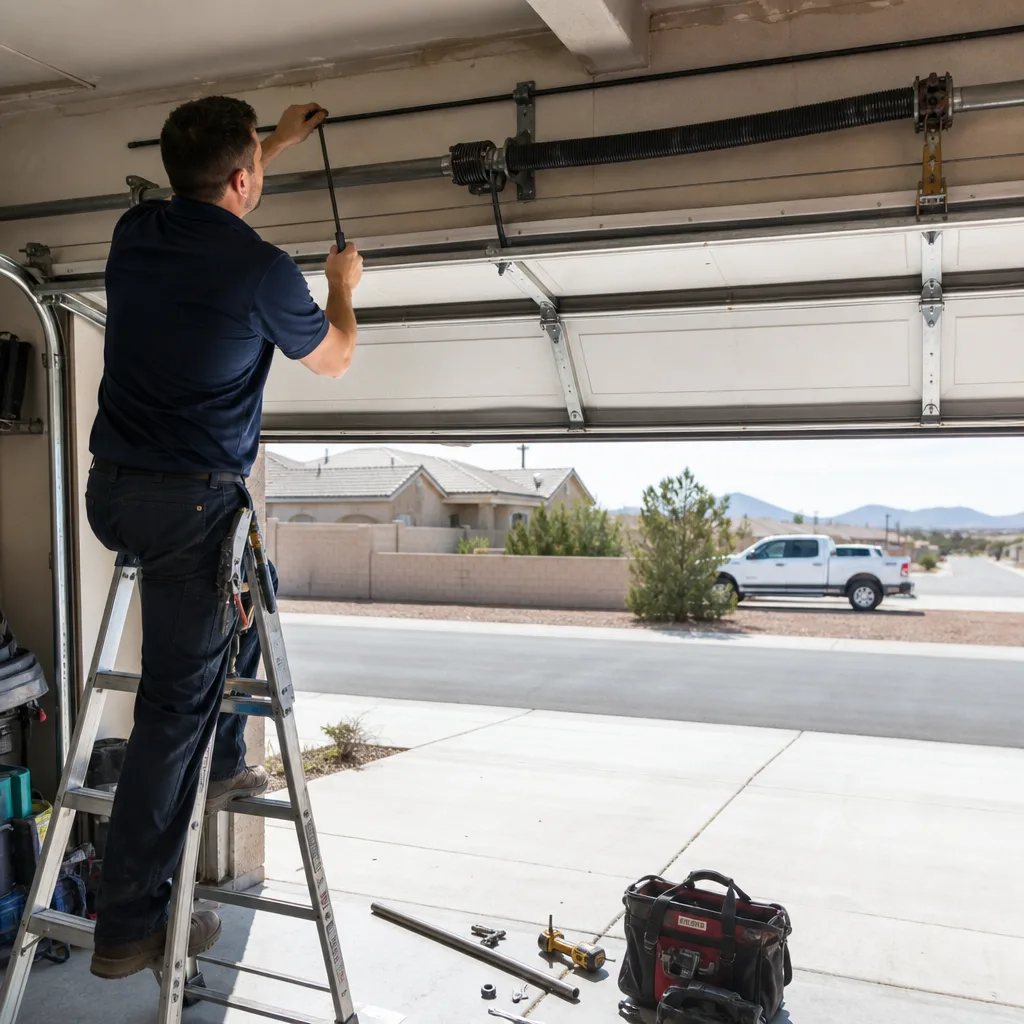
Palmdale’s real maintenance calendar runs on two service windows. The first is late September, before Santa Ana wind season establishes itself. The second is early May, before the first sustained heat spike. Everything else is monitoring. Here’s what belongs in each window.
September: Pre-Wind Season Service
- Inspect the bottom seal along its full length. Run your hand along the rubber strip at the bottom of the door. If it’s cracked, flattened, or pulling away from the aluminum retainer, replace it before the first big wind event. A compromised bottom seal lets wind-driven dust and sand into the garage, and in Palmdale, that dust finds its way into opener rail lubricant and photo-eye lenses within a single season.
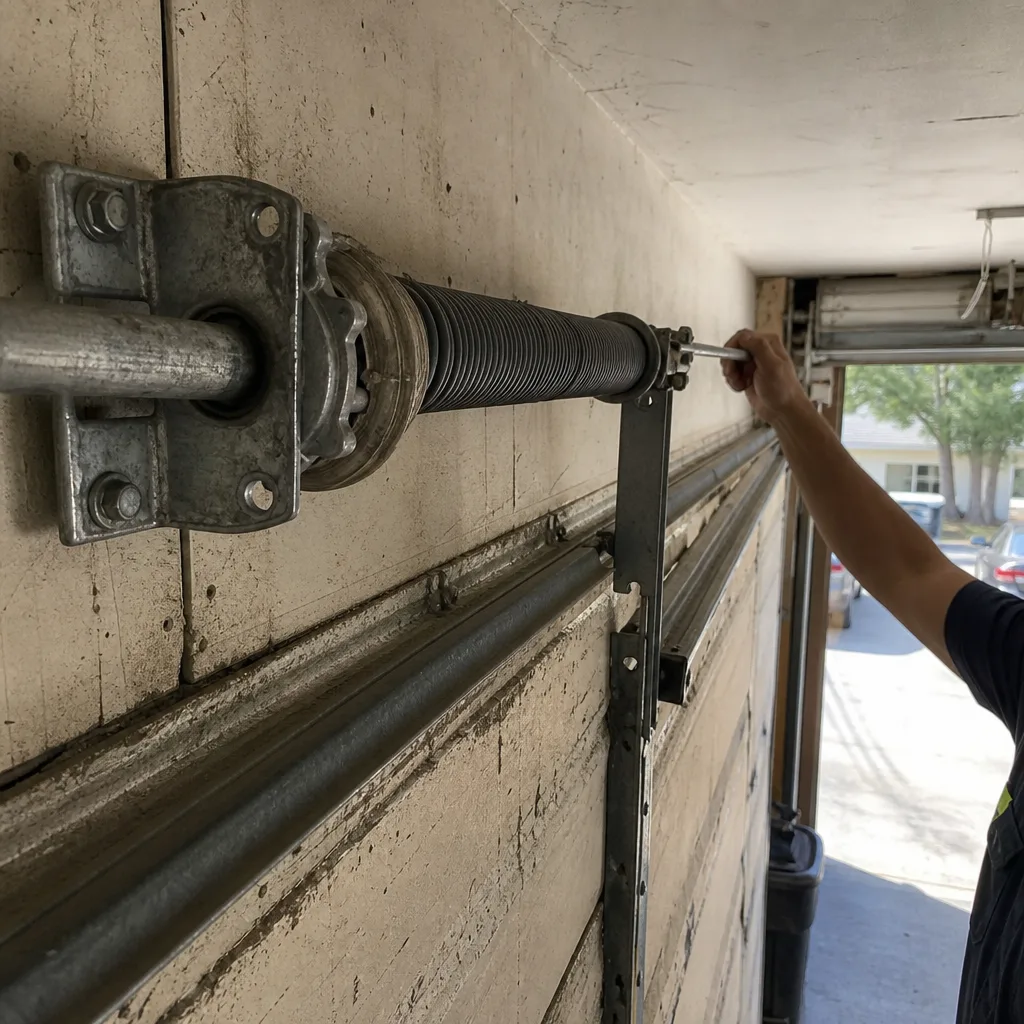
- Check both extension or torsion spring assemblies for visible wear. Look at the torsion spring above the door. If you see a gap in the coil, that spring has already failed. If the spring looks intact but the door feels heavy when you lift it manually, the spring has lost calibration and needs a tension adjustment.
- Tighten all hinge and bracket bolts. Wind loading on a 16-foot door creates vibration that works bolts loose over the course of a single summer. A loose hinge bolt is a 60-second fix in September and a bent panel by December.
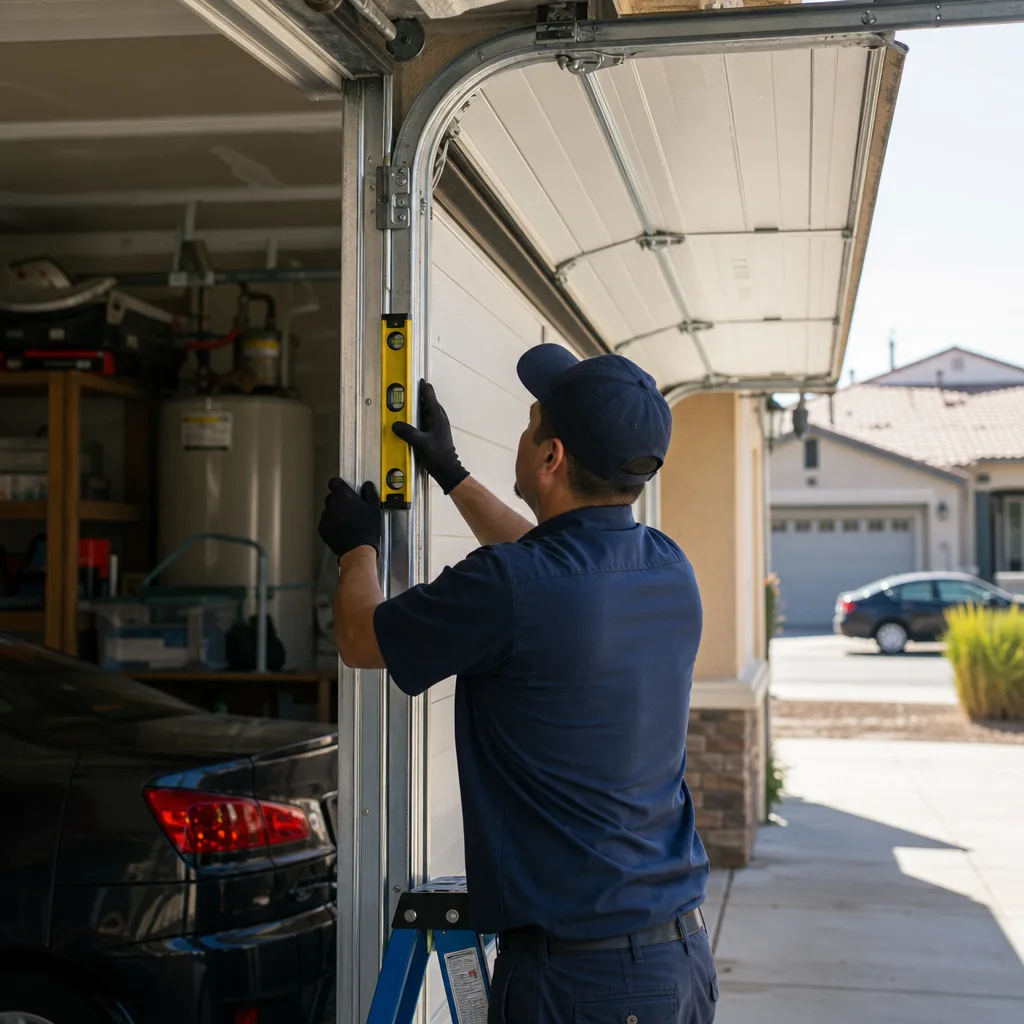
- Verify that the garage door tracks are parallel and the rollers are seated correctly. Santa Ana winds exert lateral pressure on the door face. If your tracks have drifted even an eighth of an inch out of parallel, the wind will amplify that misalignment every time a gust hits.
- Lubricate all moving points with a garage door-specific lubricant. Use a spray lubricant designed for garage doors, not WD-40. The rollers, hinges, bearing plates, and spring should all get a light coat. Wipe away excess. In Palmdale’s dry air, excess lubricant attracts dust like a magnet, and dust-laden lubricant acts as an abrasive paste.
May: Pre-Heat Spike Service
- Test the door balance. Disconnect the opener by pulling the red release handle, then lift the door to waist height. It should stay put without drifting up or down more than a few inches. If it falls, the springs are under-tensioned. If it rises, they’re over-tensioned. Either condition accelerates opener wear and shortens spring life. This matters more in Palmdale than in most markets because the summer heat spike compounds any existing imbalance.
- Inspect the photo-eye system. Clean both lenses with a dry cloth. Palmdale’s spring winds deposit a fine layer of dust that reduces the photo-eye’s effective range, and when the temperature crosses 100°F, the beam’s infrared emitter runs at reduced efficiency. A dirty lens that passes a mild-weather test may cause intermittent reversal errors in August.
- Check the opener’s force settings. The travel limit and force settings on your opener may need adjustment after spring temperature swings have changed the door’s operating characteristics. If your door reverses immediately after touching the ground, or slams into the ground and bounces, the force settings have drifted.
- Examine all weatherstripping for UV cracking. Palmdale’s July UV index routinely reaches 11, which means unprotected rubber compounds degrade at roughly double the manufacturer’s rated lifespan. We’ll cover this in more detail below, but the short version is: if your weatherstripping is more than three years old, check it carefully in May, not in the fall when you can see obvious damage.
- Listen to the opener during a full open-close cycle. Turn off your car, the radio, anything that masks sound. A healthy opener in good weather should be relatively quiet. Grinding, straining, or a rhythmic thumping that changes with door position is an early sign of worn gears or a door out of balance. Catching it in May means fixing a $120 gear assembly instead of replacing a $450 opener in August.
If this schedule feels like a lot to track, it’s worth remembering that both windows take about 30 minutes each. The repairs they prevent routinely run into the hundreds. And if you’d rather not do any of it yourself, garage door repair in Palmdale from a qualified technician includes a full 25-point inspection as part of the visit. The key is that the inspection happens before the failure, not after.
How Summer Heat Affects Torsion Springs: Symptoms Before Failure
A torsion spring stores mechanical energy by twisting. When a garage door opens, the spring unwinds and releases that energy to lift the door. When the door closes, the spring winds back up. In Palmdale, the metal in that spring is subjected to a daily thermal cycle that few other parts of your home experience. At 2:00 p.m. on a July afternoon, the air inside an uninsulated garage can reach 120°F or more. At 5:00 a.m. in January, that same garage might be 28°F. The steel in the spring expands and contracts with every one of those swings.
Over time, this thermal expansion changes the spring’s effective tension, even if the spring never physically breaks. The symptom you’ll notice first is subtle: the door feels slightly heavier when you lift it manually, or the opener motor sounds like it’s working harder than it used to. A door that’s drifted out of balance by even 10% is transferring that extra load directly to the opener’s gear train and the cable drums. In our experience in Palmdale, we’ve seen openers fail within 18 months of a spring losing calibration, simply because the motor was working 15-20% harder than it was designed to on every single cycle.
What to look for before the spring actually snaps:
- The “heavy door” test. Disconnect the opener and lift the door manually. If it takes noticeable effort to raise it from the closed position, the spring has lost tension. A properly calibrated door should feel nearly weightless for the first foot of travel.
- Visible coil separation. Look at the spring mounted above the door. If you can see daylight between any two coils, the spring has failed and needs replacement. This is the one case where the symptom and the diagnosis are literally the same thing.
- Uneven gaps when the door is closed. If the door closes but leaves a larger gap on one side than the other, the spring may be unloading asymmetrically. This is a precursor to cable drum problems.
- A door that opens partway and stops. If your door opens a foot or two and then reverses or stalls, the spring is likely under-tensioned and the opener’s force sensors are doing their job by shutting the door down before the motor burns out.
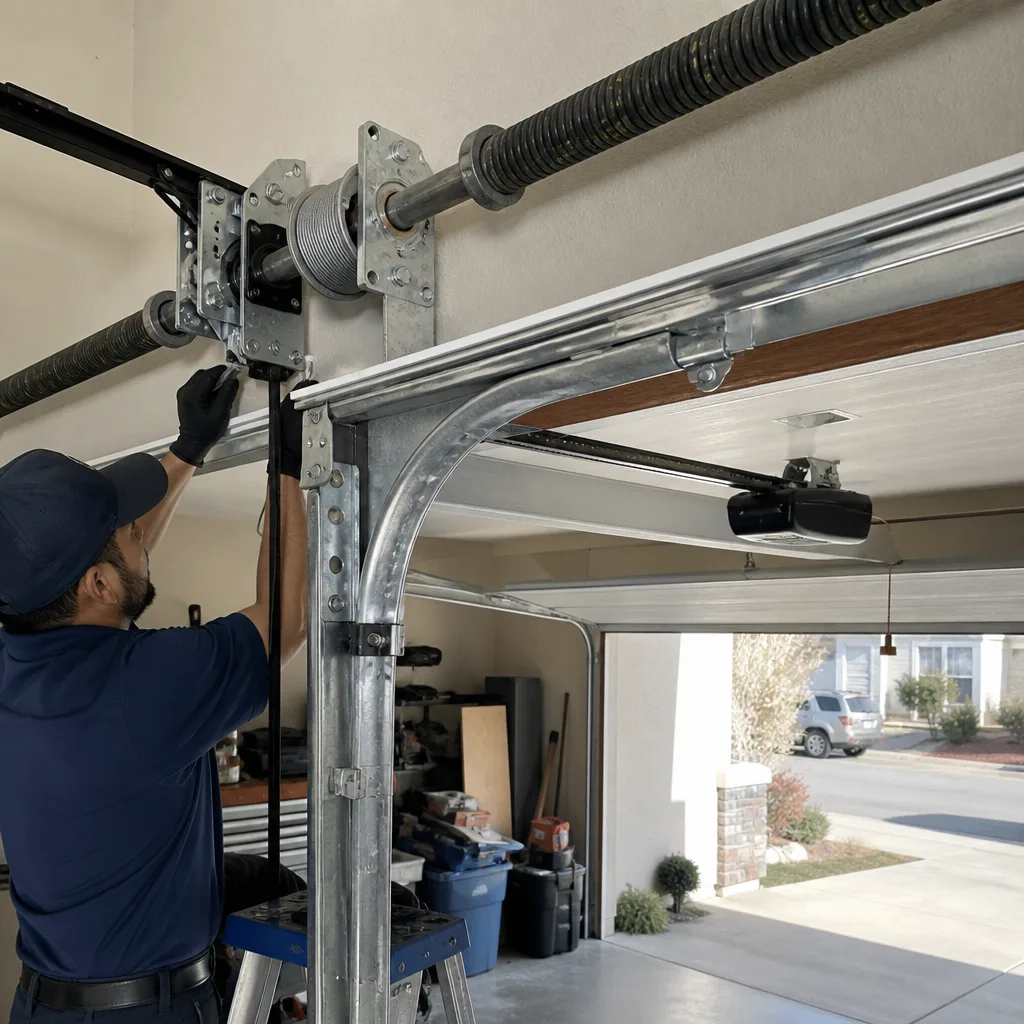
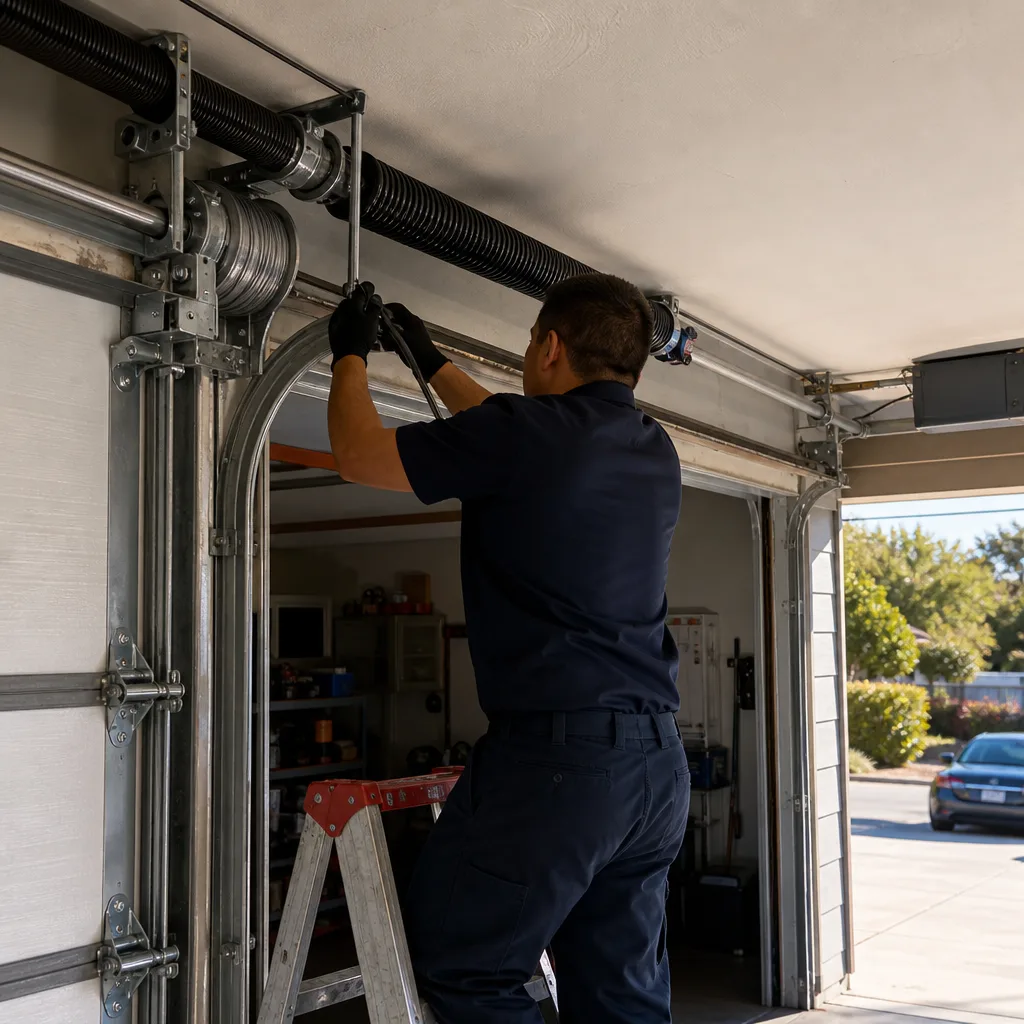
Spring tension calibration is a job we recommend leaving to a professional. Torsion springs are under enormous tension, and adjusting them without the proper winding bars is one of the most dangerous repair jobs in a home. A spring that’s improperly wound can release its stored energy suddenly and cause serious injury. An installation or replacement visit from a qualified Palmdale garage door technician includes the calibration work, the safety inspection, and the documentation of exactly what was found and what was adjusted.
Bottom Seals and Weatherstripping: What the High Desert UV Actually Does
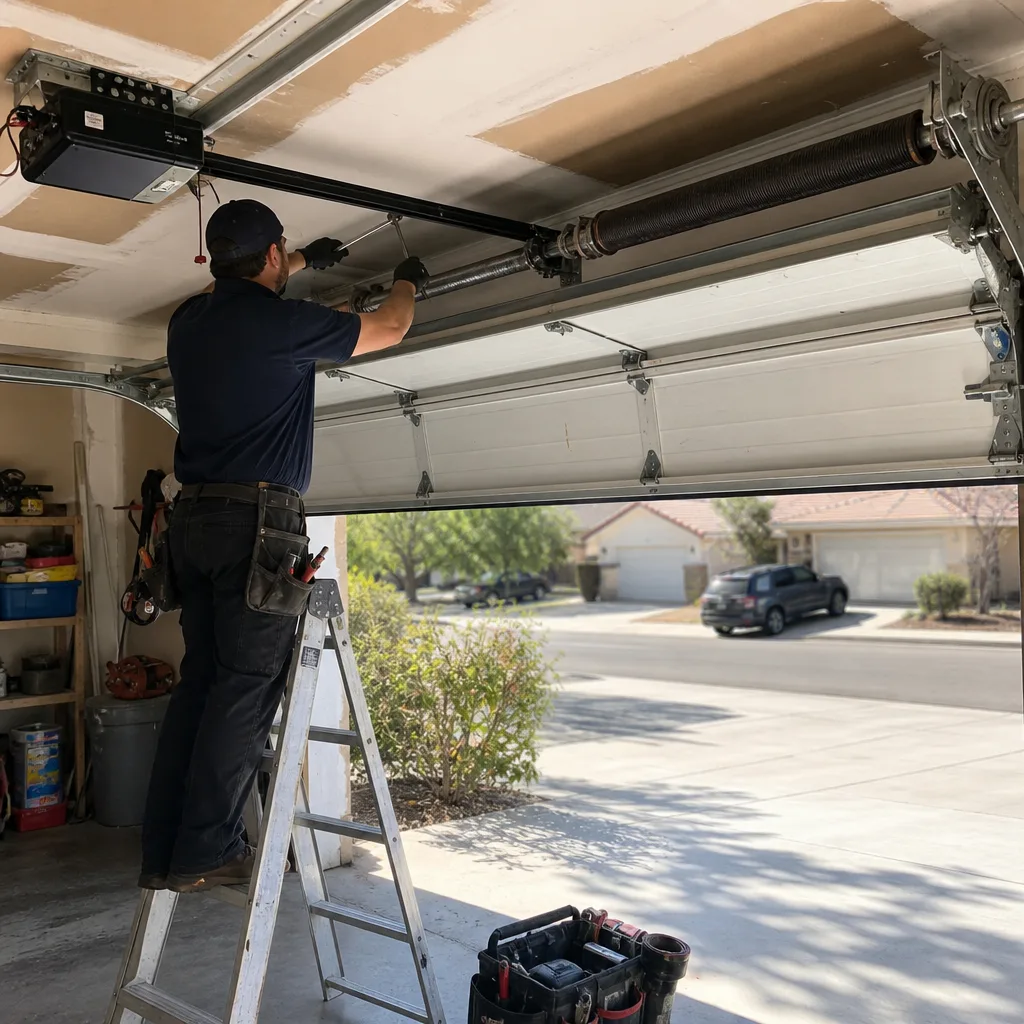
Manufacturer lifespan ratings for garage door bottom seals are typically based on coastal or inland temperate conditions. A vinyl bottom seal rated for five years in San Diego will often fail in three years in Palmdale, sometimes less if the door faces south or west and gets direct afternoon sun. The ultraviolet radiation in the high desert breaks down the plasticizers that keep vinyl and rubber compounds flexible. Once those plasticizers are gone, the seal becomes brittle, it cracks, and it stops making contact with the concrete slab.
What this means in practice is that a Palmdale homeowner should expect to replace the bottom seal every 24 to 36 months, not every five years. The seal is the single cheapest component on your garage door and the one that most directly protects the rest of the door from damage. A failed bottom seal lets wind-driven dust into the garage, which contaminates the lubricant on the opener rail and the rollers. That contaminated lubricant becomes abrasive. The damage from a neglected seal doesn’t show up in the seal itself; it shows up six months later in a noisy opener and worn roller bearings.
Seal compounds matter more in Palmdale than anywhere else in California. Here’s what holds up:
- Thermoplastic elastomer (TPE) seals hold up significantly better than standard vinyl in high-UV environments. They cost $30 to $60 as a DIY replacement for a standard 16-foot door, and they typically outlast vinyl by a factor of two in Palmdale conditions.
- Standard vinyl seals work and are the cheapest option at $20 to $40, but expect to replace them every two years if your door gets afternoon sun. If your door faces north and is shaded, you can stretch that timeline.
- Bulb-style seals with a wider profile make better contact on uneven Palmdale slabs. The freeze-thaw cycle here isn’t as dramatic as in colder climates, but the clay-heavy soil in some Antelope Valley neighborhoods does shift, and a wider bulb seal absorbs that movement better than a flat profile.
- Side and top weatherstripping follows the same degradation curve as bottom seals but gets less direct sun in most installations. Check the door jamb strips every May. If the rubber has turned from dark gray to chalky white, it’s time to replace it, even if it hasn’t cracked yet.
One thing that’s unique to Palmdale: the combination of low humidity and high UV creates a specific failure mode we call “sunburn sealing.” The seal doesn’t crack like it does in freeze-thaw climates; instead, it hardens and shrinks slightly, pulling away from the door edges by an eighth of an inch. That gap is invisible from inside the garage but it’s enough to let wind-blown dust through. If your garage has failed the “dust on the workbench” test every spring despite a seal that looks intact, this is likely the cause.
Cold-Morning Opener Sluggishness: What’s Happening and How to Fix It
Palmdale’s January nights drop below freezing with regularity, and the early hours before sunrise are often the coldest part of the day. If you’ve ever pressed the button on a January morning and watched your garage door open in what looks like slow motion, you’re observing a real physical phenomenon, not a failing motor. The issue is lubricant viscosity.
Garage door openers use a grease or oil lubricant on the drive screw, chain, or belt. As temperature drops, the viscosity of that lubricant increases. The lubricant thickens, which increases the rolling resistance of the chain or the friction of the drive screw, which makes the motor work harder, which slows the door down. The same principle affects the bearings in the rollers and the pivot points on the hinges. At 30°F, a garage door opener can be working 30% harder than it does at 70°F simply due to lubricant viscosity changes.
Here’s what you can do about it without a service call:
- Switch to a low-viscosity synthetic lubricant. Most hardware-store garage door lubricants are petroleum-based and get stiff in cold weather. A synthetic or silicone-based garage door lubricant maintains more consistent viscosity across a 70-degree temperature range. Apply it to the chain or screw drive in the fall, before the cold nights arrive.
- Don’t over-lubricate. More lubricant makes the problem worse in cold weather. A thin, even coat is all you need. Excess lubricant pools and thickens like cold syrup.
- Check the chain or belt tension. Cold weather shrinks metal, and a chain that’s correctly tensioned at 80°F can be too tight at 30°F. If your chain has visible slack or your belt seems to strain on cold mornings, a tension adjustment may be in order.
- Warm the garage if possible. This isn’t always practical, but an insulated garage door makes a meaningful difference. The temperature difference between an insulated and uninsulated garage on a Palmdale winter night can be 15 degrees, which is enough to take the edge off the lubricant viscosity problem.
- If the problem persists at all temperatures, it’s not the lubricant. An opener that’s slow in July is not suffering from viscosity issues. That’s a sign of a failing capacitor, worn gears, or a door that’s out of balance. That diagnostic work is a job for a technician.
One brand note: modern LiftMaster and Chamberlain openers with DC motors handle cold-morning starts better than older AC-motor models. They ramp up gradually instead of hitting full speed instantly, which reduces the initial load spike on cold lubricant. If you have a Genie opener from before 2010, cold-morning sluggishness is a well-documented characteristic of the model line, and it often improves with a lubricant change and a capacitor check rather than a full opener replacement.
Post-Windstorm Inspection Protocol for Santa Ana Season
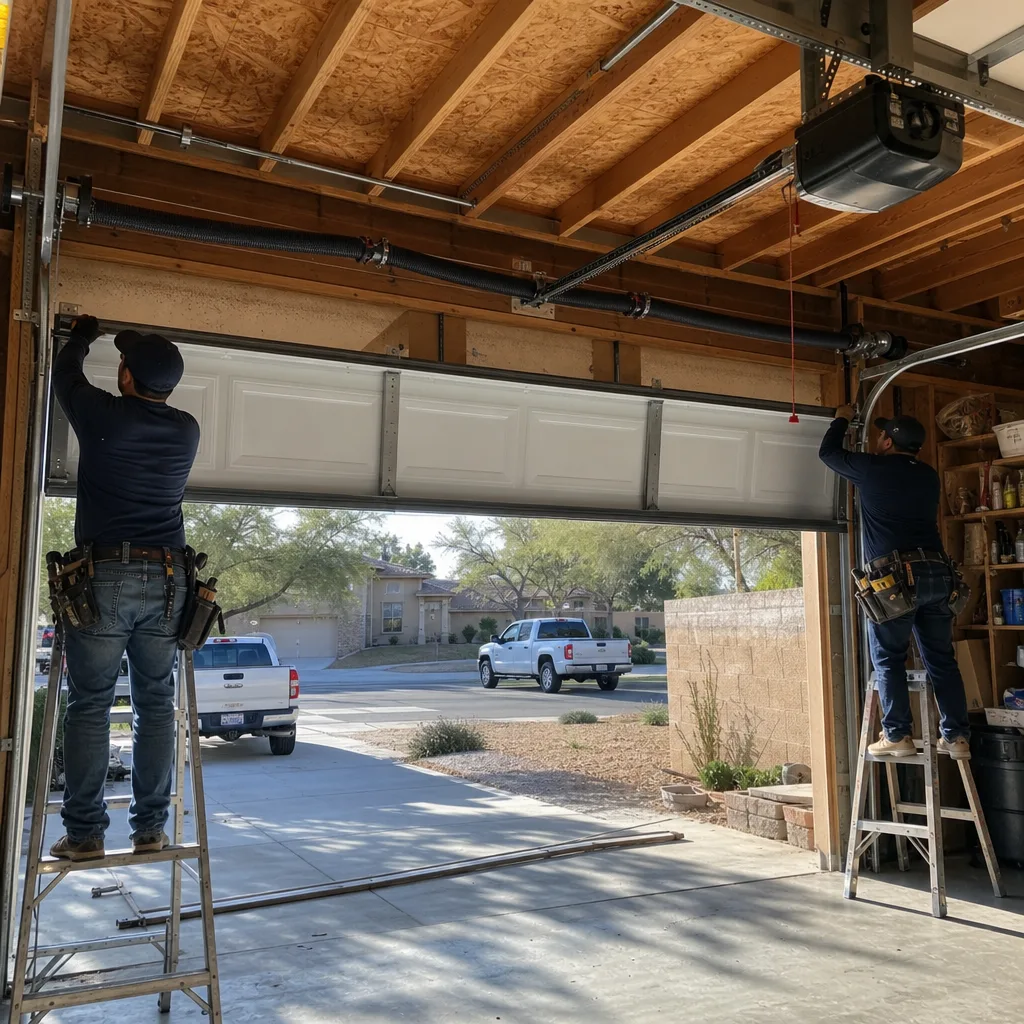
Santa Ana winds in Palmdale typically run from October through March, with the strongest events in November and December. Sustained winds of 30 to 40 mph with gusts above 60 are common during peak events. That’s enough sustained lateral force to move a 16-foot garage door several inches off plumb, and that movement transfers directly to the tracks, hinges, and cable system. After any wind event where you can hear the wind through the garage door or see the door flex, run through this inspection sequence:
- Stand inside the garage and visually check the gap between door and floor. Close the door and look for daylight along the bottom edge. A gap that appears on one side after a windstorm is a sign the door has shifted on its brackets.
- Check the tracks where the rollers connect. Look at the vertical track on both sides. If the track appears bowed or the door doesn’t sit centered between the left and right tracks, the track has moved. This is the most common wind-related failure we see in Palmdale, and it’s fixable without replacing parts if caught early.
- Run the door through a full open-close cycle and listen. A grinding or popping sound from the roller area during travel means a roller is binding against a misaligned track. Each cycle with a binding roller puts wear on both the roller and the track itself. Catching it now means replacing a $18 roller instead of a $200 track section six months later.
- Check the cable tension on both sides. With the door closed, look at the cables running from the bottom brackets up to the cable drums above. Both cables should be taut. If one appears slack, the door has shifted and the cable is no longer carrying its share of the load. A slack cable can jump its pulley and tangle, which turns a minor track adjustment into a major repair.
- Inspect the exterior panels for dents from wind-borne debris. A dent in a steel panel is usually cosmetic until it isn’t. A deep dent near an edge or a stile can weaken the panel’s connection to its hinge, which creates stress concentration points that tear under repeated wind loading. If a panel is dented near its hinge points, it should be replaced before the next wind season.
After the inspection, make a note of anything unusual and keep an eye on it over the next few weeks. Wind-related damage is often progressive. A track that’s slightly out of alignment in November can be significantly out of alignment by February if the door keeps cycling against it. If you’d rather have a professional handle the post-storm check, opener repair and inspection services in Palmdale include this protocol as part of a standard service call.
Common Mistakes to Avoid
- Following a generic four-season maintenance schedule. The spring and fall checkpoints that work in coastal California don’t map to Palmdale’s actual stress pattern. Checking your door in March and October is fine, but it means you’re inspecting six months after the damage happened instead of six weeks before the stress event.
- Using WD-40 as a garage door lubricant. It’s a solvent with light lubricating properties, not a garage door lubricant. It strips existing lubrication and leaves moving parts essentially dry within days. In Palmdale’s dusty environment, that turns the rollers and hinges into dust traps.
- Ignoring a noisy door because “it’s always been that way.” Noise is the earliest diagnostic signal you’ll get. A door that’s gradually gotten louder over the course of a year is telling you that something is wearing. Fixing the underlying cause early is almost always cheaper than waiting.
- Replacing the bottom seal without checking the retainer track. The aluminum retainer that holds the seal can bend, especially after wind events or if the door has been backed into. A new seal in a bent retainer won’t make contact along the full length, and you’ll have the same dust problem with a brand-new seal.
- Attempting torsion spring adjustment as a DIY project. The spring assembly holds enough energy to cause severe injury if it releases while improperly handled. This is one of the few garage door repairs that genuinely requires professional tools and training, and no amount of YouTube instruction changes that.
- Using a standard extension cord to power an opener during a power outage. Garage door openers draw substantial current at motor startup. An undersized extension cord can cause voltage drop that damages the opener’s logic board, and a damaged logic board is far more expensive than the inconvenience of waiting for power restoration.
- Skipping the September inspection because “the door still works fine.” The entire point of seasonal maintenance is to catch problems before the door stops working fine. Every Palmdale homeowner we’ve worked with who waited until the door failed spent more than they would have on preventive maintenance.
When to Call a Professional
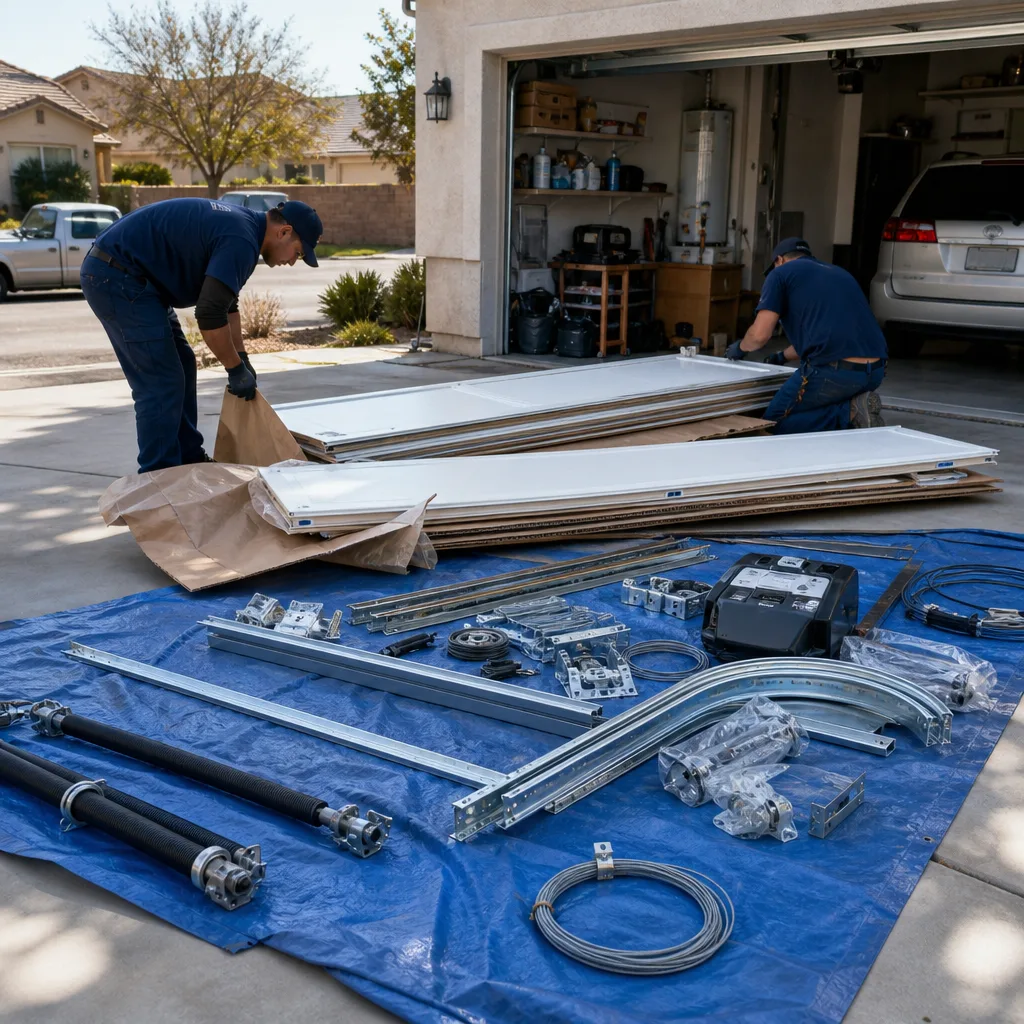
Some garage door work is genuinely safe for homeowners to handle: lubrication, seal replacement, photo-eye cleaning, and the visual inspections described above. Others are not. Call a professional if you see a visible gap in a torsion spring, if your cables are frayed or slack, if your tracks are visibly out of parallel, or if your door has come off its rollers entirely. These are not maintenance items; they’re repair items with real safety implications. The spring and cable systems on a garage door operate under tension, and the failure mode is sudden and unpredictable. Servo Garage Doors Palmdale offers free estimates in Palmdale; call (661) 449-2581 and we’ll tell you the price range before we arrive.
Frequently Asked Questions
Twice a year is the minimum for Palmdale specifically, with service windows in late September and early May. These two checkpoints align with the two environmental stress events that cause the most garage door failures in the Antelope Valley: Santa Ana wind season and the summer heat spike. A 30-minute inspection in each window catches most developing problems before they become repair calls.
The most common summer problem we see in Palmdale is opener failure caused by an out-of-balance door. The door drifts out of balance as torsion springs lose tension from thermal cycling, the opener works progressively harder on every cycle, and by August the motor or gear assembly fails. The fix is usually a spring tension adjustment, not an opener replacement, but only if the imbalance is caught before the opener burns out.
Replacing a bottom seal is a reasonable DIY job for most homeowners. The seal slides into an aluminum retainer channel, and a 16-foot replacement costs $30 to $60. The main thing to check before you start is whether the retainer itself is straight. A bent retainer means the new seal won’t make even contact with the slab, and that’s a repair job for a technician. Call (661) 449-2581 for the exact cost if you’d rather have it done professionally; estimates are free.
Cold-morning slowness is caused by lubricant viscosity changes at low temperatures. The grease or oil on the drive mechanism thickens when the temperature drops below freezing, which increases friction and makes the motor work harder. Switching to a low-viscosity synthetic lubricant and applying it correctly in the fall resolves most cases. If the slowness persists at all temperatures, the problem is likely a failing capacitor or worn gears, not the lubricant.
After a significant wind event, check five things in order: the gap between the closed door and the floor on both sides, the tracks for bowing or misalignment, the sound of the door during a full cycle, the tension on both lift cables, and the exterior panels for dents near hinge points. Track misalignment from wind loading is progressive, and catching it early means a simple realignment instead of a track replacement later.
Standard torsion springs are rated for 10,000 cycles, which translates to roughly 7-10 years of typical use in most climates. In Palmdale’s thermal cycling environment, we typically see meaningful tension loss well before the spring physically breaks, often in the 5-7 year range. This is why the twice-yearly balance test matters: the spring may be degrading long before it fails, and the symptom you’ll see first is a door that feels heavier, not a broken spring. Call (661) 449-2581 for an exact quote on spring replacement; all pricing is provided in writing before any work starts.
The Bottom Line
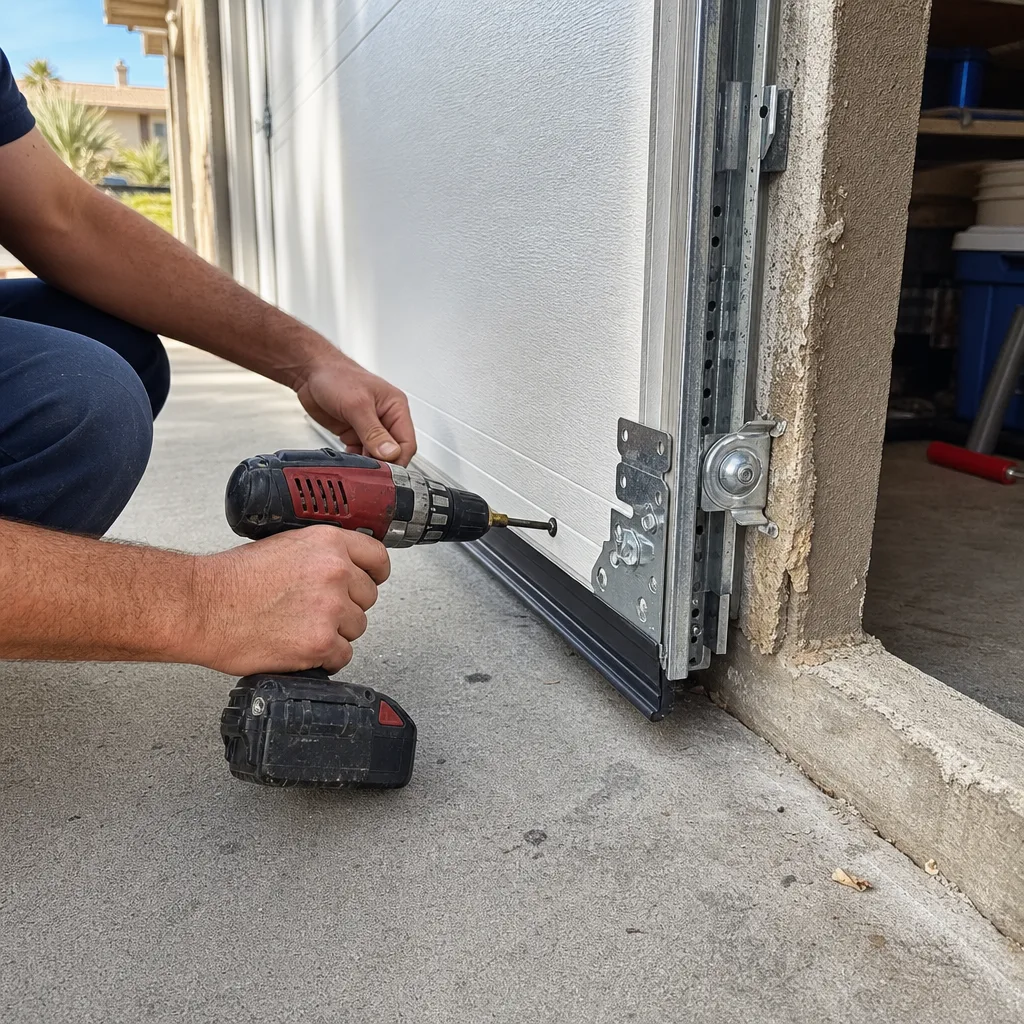
Palmdale garage doors fail on a different schedule than any maintenance guide written for coastal California predicts. The two service windows that matter are late September and early May. The two components that fail most often are torsion springs and bottom seals. The two conditions that drive those failures are thermal cycling from 100-degree summer days and the lateral force of Santa Ana winds. If you do one thing this year, do the 30-minute September inspection: check the bottom seal, test the door balance, listen to the opener, and tighten what’s loose. It’s the highest-value half hour you’ll spend on home maintenance in Palmdale, and it means your garage door serves your Palmdale home through another wind season and another summer without an emergency.
Written by Marcus Deller, Owner at Servo Garage Doors Palmdale, serving Palmdale since 2015.