
Last updated September 20, 2026
Full 25-point door and opener safety check with every visit - springs, cables, rollers, tracks, and your LiftMaster or Chamberlain opener included
You get a price before we start. It does not change when the truck arrives.
 Before
 After
After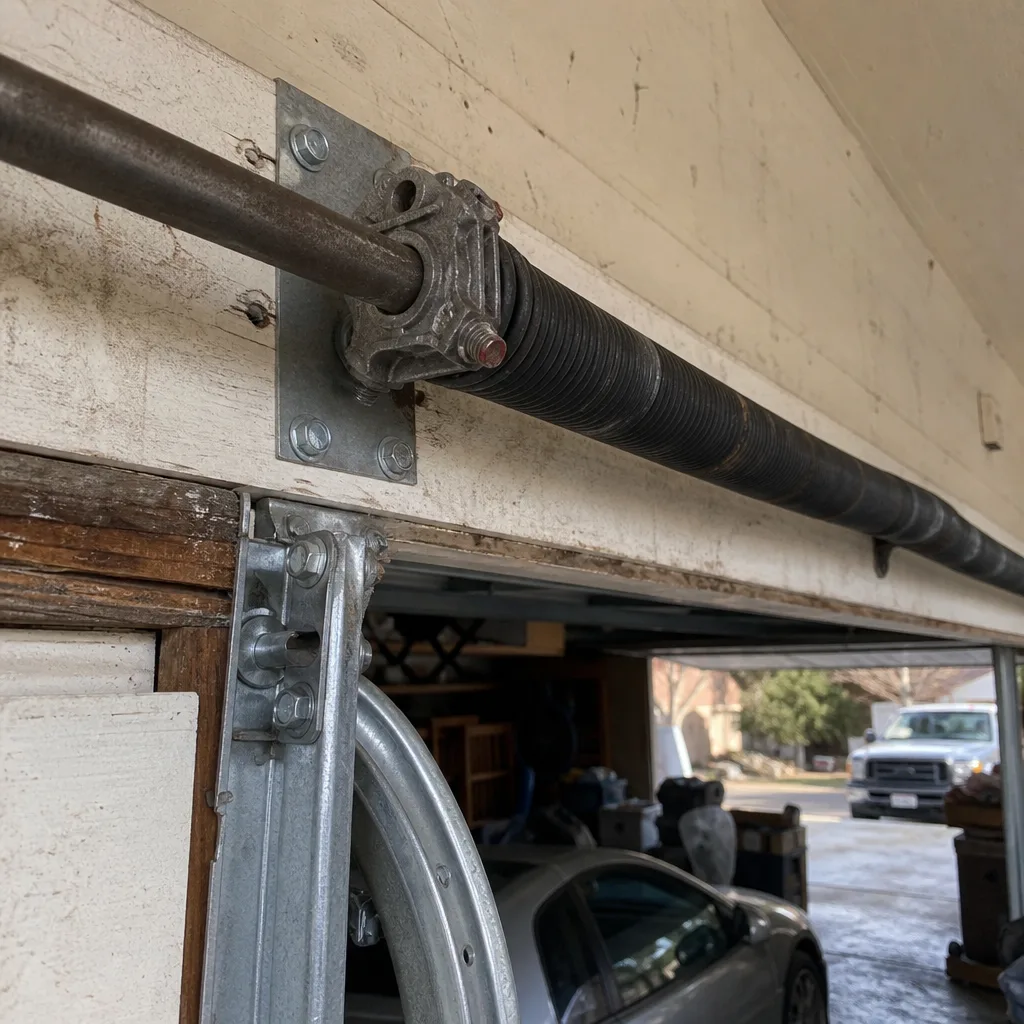 Before
 After
After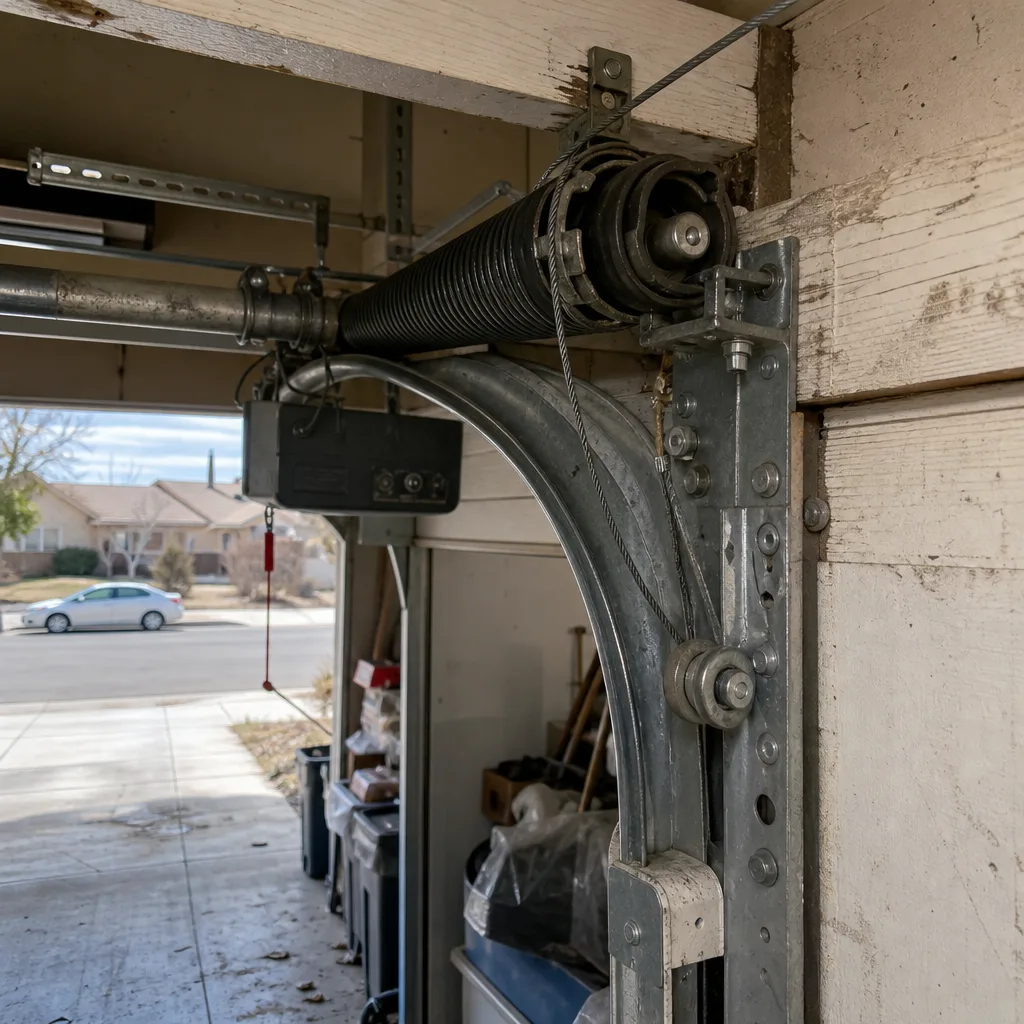 Before
 After
AfterGarage Door Warning Signs: A Palmdale Homeowner’s Reference Guide
Most garage door guides wait until the door refuses to move before they call it a warning sign. That’s not a warning. That’s an obituary. The useful information starts weeks earlier, and it’s rarely written down anywhere a homeowner can find it. A torsion spring under load produces measurable changes in how the door balances for four to eight weeks before it snaps. A roller with a failing bearing makes a specific sound at day seven that it did not make at day thirty. This guide works backward from the moment of failure to the first observable indicator, so a Palmdale homeowner has a real window to act instead of a midnight emergency call. For a broader overview of maintenance and options, see our The Complete Guide to Garage Door in Palmdale.
Quick Answer
The earliest garage door warning signs in Palmdale are a door that drifts downward when manually released, a grinding sound from the roller track that changes pitch over two weeks, cable strands that look fuzzy instead of smooth, and visible corrosion at the torsion spring’s coil ends. If you observe any one of these, you typically have days to weeks before failure, not months. A door that shakes on the way up, by contrast, has usually been telling you something for a month already.
Table of Contents
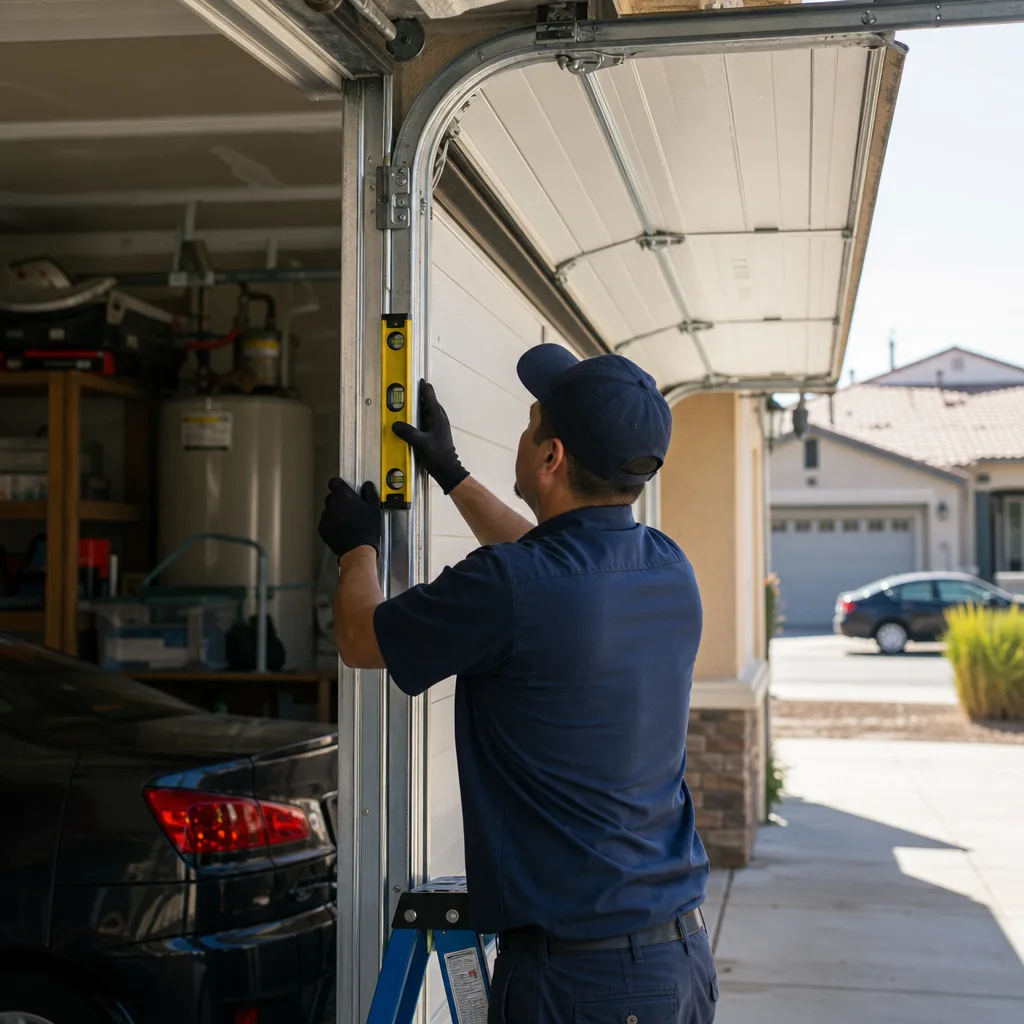
- The Torsion Spring Failure Sequence: 30 Days to Snap
- Cable Failure: What Fraying Actually Looks Like at Each Stage
- Roller Bearing Failure: The Sound Signature Few People Connect to the Problem
- Opener Logic Board Failure: When the Motor Runs but the Door Doesn’t
- The 10-Second Manual Lift Test: Separating Balance, Track, and Opener Problems
- Palmdale-Specific Warning Signs: Sand, UV, and Wind
- Safe to Monitor vs. Same-Week Service: A Plain Binary
- What to Photograph When You See a Warning Sign
- Common Mistakes to Avoid
- When to Call a Professional
- Frequently Asked Questions
 Before
 After
AfterThe Torsion Spring Failure Sequence: 30 Days to Snap
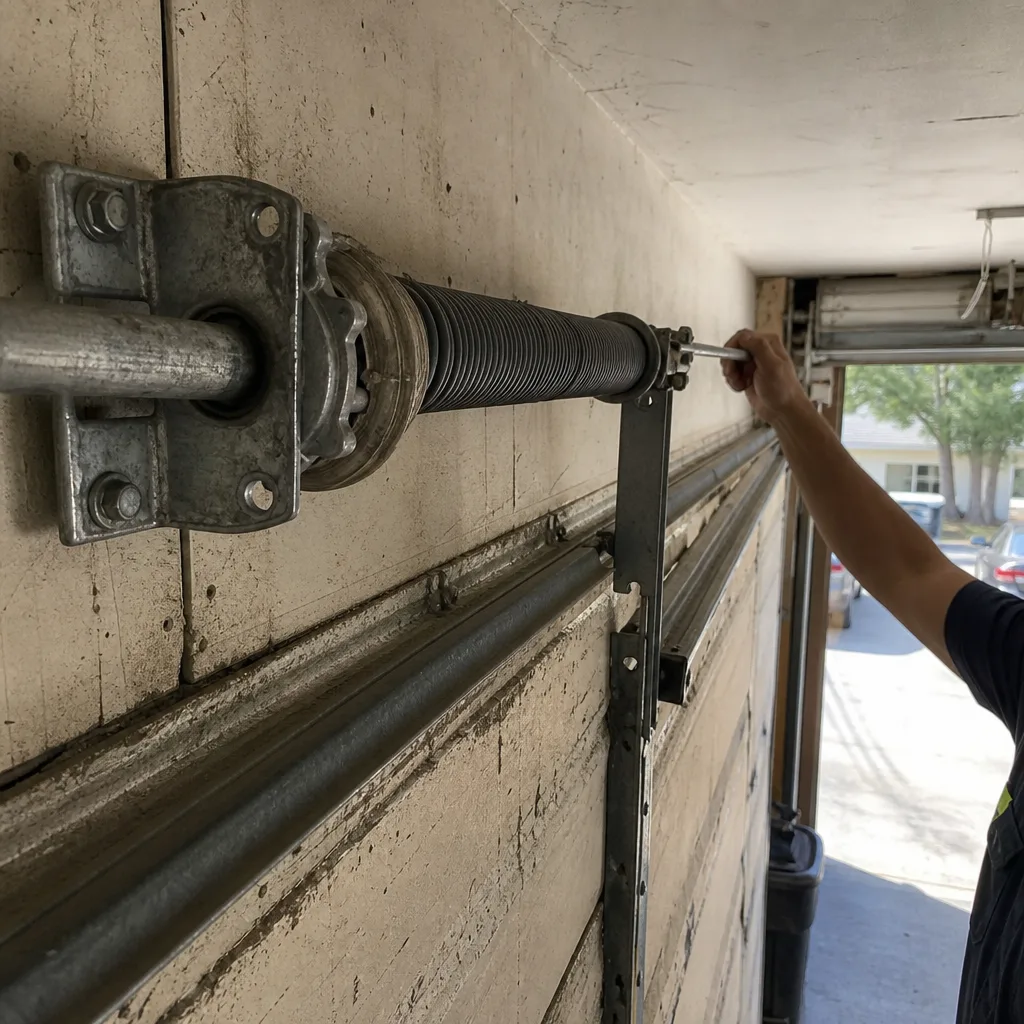
A torsion spring is a steel coil mounted above the door opening that stores the lifting energy for the door. Most residential springs are rated for 10,000 cycles, which translates to roughly seven to ten years of normal use in a Palmdale household that opens the door twice a day. When a spring begins to fail, it does not fail silently. It produces a sequence of observable changes that progress over several weeks.
Here is what we document on service calls across Palmdale, from the earliest sign to the moment of fracture:
- Day 30 to 20: The door feels heavier during manual release. If you pull the red emergency cord and lift the door by hand, it requires noticeable effort at the halfway point. The spring has lost tension but not yet integrity.
- Day 20 to 10: The door begins to sag on one side. You may notice a gap of a quarter to half an inch between the bottom seal and the floor on the left or right. The spring’s coils are beginning to separate unevenly.
- Day 10 to 7: You hear a sharp pop or creak from above the door when it opens. This is the spring’s coil surfaces grinding against each other as internal stress redistributes. It is not normal, and it will not go away.
- Day 7 to 3: The door opens slower than the opener motor expects. The opener’s logic board detects the increased resistance and adjusts, but the result is a visible hesitation at the top of the travel.
- Day 3 to 1: A gap appears between two adjacent coils on the spring itself, visible if you stand on a ladder and inspect the spring. The spring has begun to separate internally.
- Hour zero: The spring snaps. The sound is frequently described as a gunshot or a car backfiring. The door will not lift by hand or by motor.
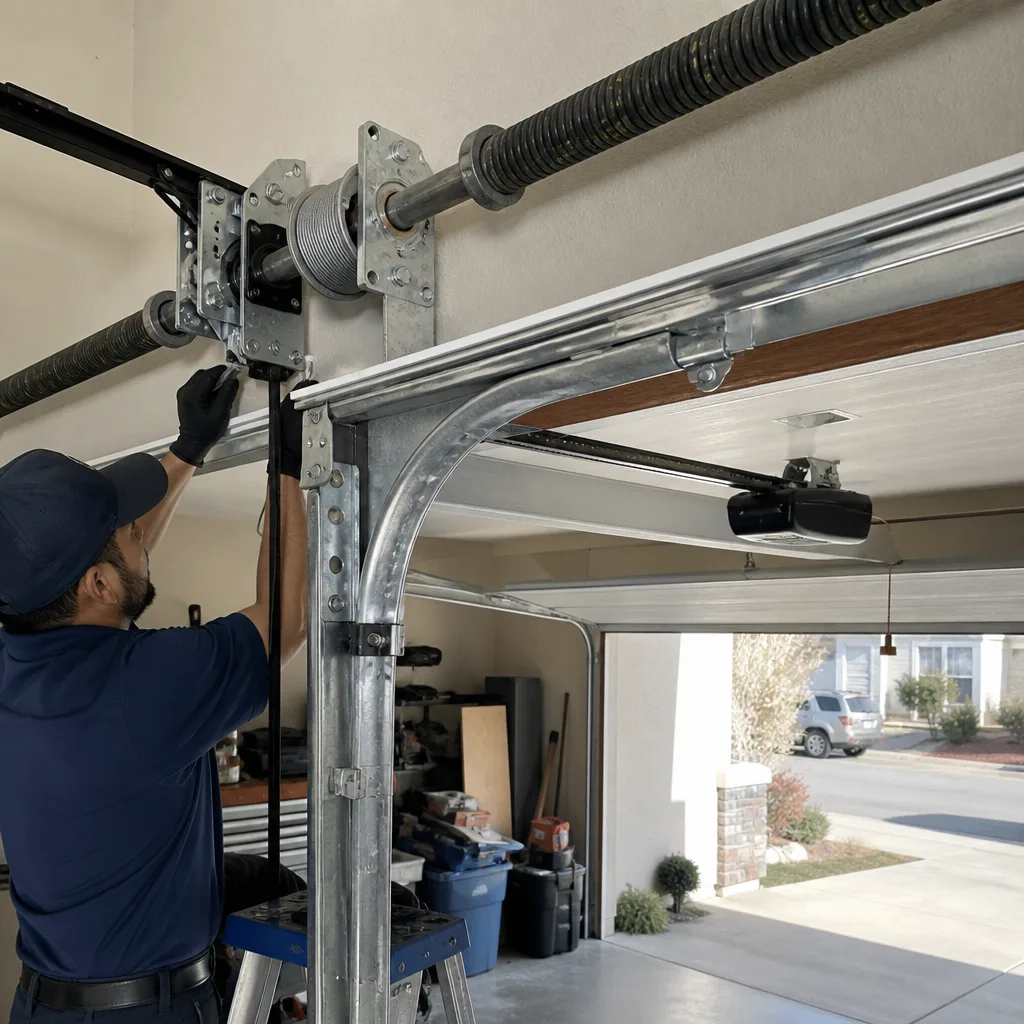
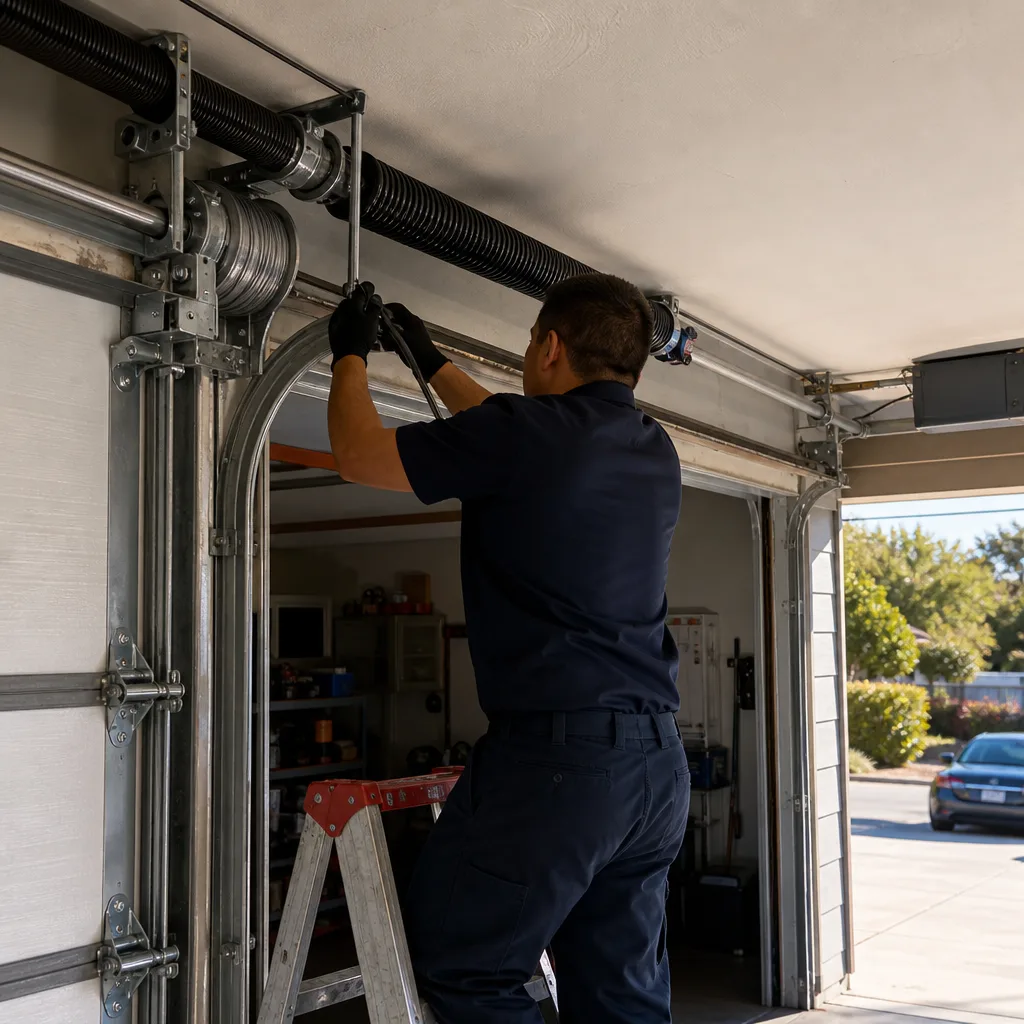
If you are in Palmdale and you have reached any point on this timeline, you still have time to schedule a repair on your terms, rather than discovering the break at 11:45 p.m. when the car is stuck inside. A snapped spring is a genuine safety event: the spring is under hundreds of pounds of tension when installed, and attempting to unwind or replace one without the proper winding bars is how serious hand and facial injuries happen. This is not a do-it-yourself repair, and we state that plainly. The cost at the bench is predictable; the cost of an improvised repair is not.
If you are reading this guide because you already suspect spring trouble, start with our Garage Door Repair in Palmdale page for what a repair visit includes, written before anyone touches the door.
Cable Failure: What Fraying Actually Looks Like at Each Stage
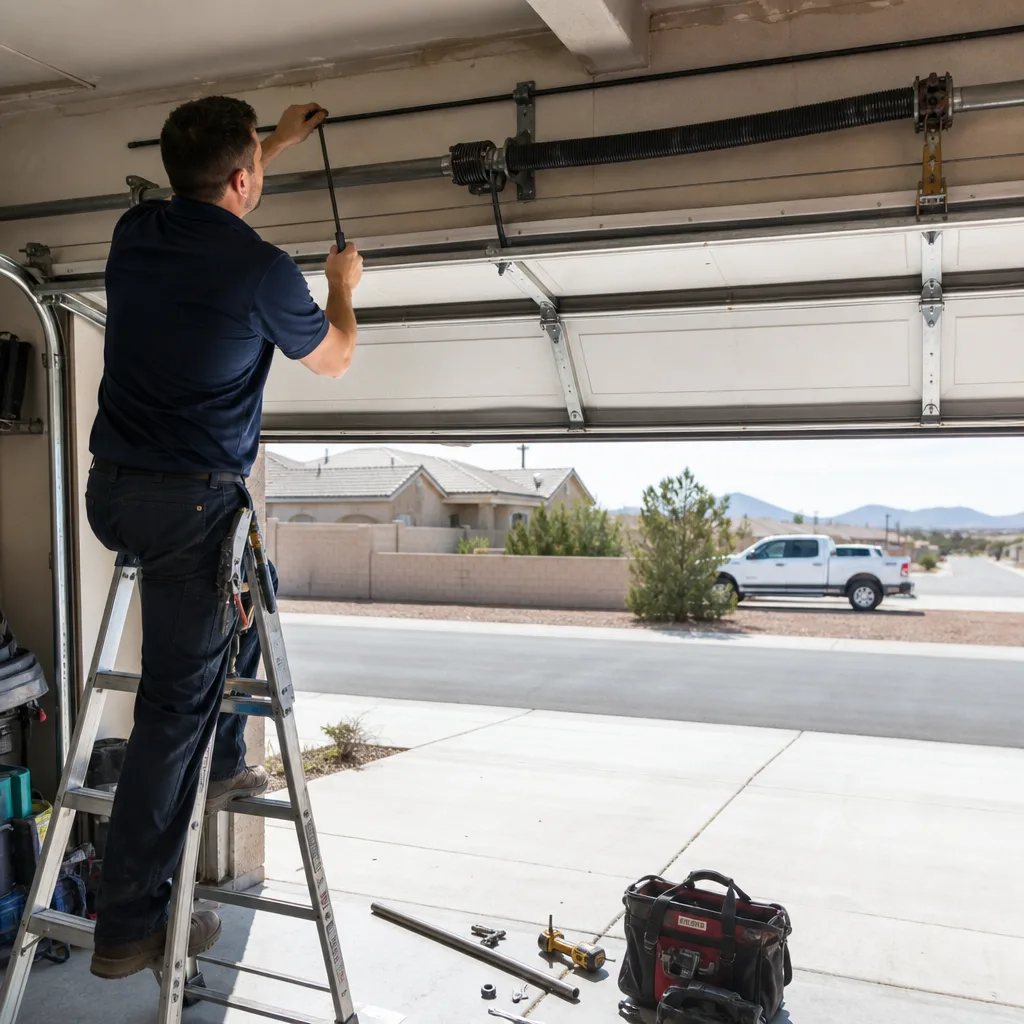
The lift cables are the braided steel lines that run vertically on both sides of the door and transfer the spring’s torque into the door brackets. They live under constant tension. A cable does not “wear out” in a vague sense; it fails strand by strand, and each stage is visible if you know what to look for.
At 30 days before failure, a cable will show a light haze of fine hair-like steel fibers near the pulley. At 14 days, individual strands begin to separate from the bundle. At 7 days, the cable appears fuzzy over a span of several inches, like a guitar string unravelling. At 24 hours, the cable shows a distinct kink or a visible reduction in diameter, often right at the point where it passes over the top of the pulley. Then it snaps, and the door drops on one side and cocks itself in the track.
The most dangerous part of cable failure is the temptation to keep using the door. A frayed cable in Palmdale will often continue to lift the door for days or even weeks after the first fuzz appears. That lulls homeowners into delaying service. The problem is that the remaining strands are now carrying the full load, and a failure under load means the door can drop suddenly. The door weighs between 150 and 300 pounds depending on the material and insulation. Nobody wins that fight.
In our experience, cable fraying is the single most photographed finding we deliver to Palmdale homeowners. Clause 4 of The Haven Standard requires that we photograph the failed component before quoting a replacement, and a close-up of a fuzzy cable is often the first time a customer has actually seen what we are describing. It’s not a sales moment. It’s a documentation moment, and it works. For newer doors or full replacements, our Garage Door Installation in Palmdale page covers what a proper install includes so cables never get a head start on failure.
Roller Bearing Failure: The Sound Signature Few People Connect to the Problem
Garage door rollers ride inside the vertical and horizontal tracks. Most residential doors have ten to twelve rollers, and each roller contains a small steel bearing. When a bearing begins to fail, the roller stops rolling freely and starts dragging. The sound is distinctive: a grinding or rattling noise that moves with the door and changes pitch as the door accelerates on the way up or slows on the way down.
The common mistake is attributing the sound to a dirty track. A dirty track produces a scraping sound that is constant. A failing bearing produces a sound that seems to “flap” or rattle in time with the door’s movement. Here is the plain distinction: spray the track lightly with a lubricant. If the sound changes, it was friction. If the sound does not change, it is the bearing, and lubrication will not fix it.
What we see in Palmdale specifically is roller bearing failure that is accelerated by sand. The Antelope Valley sits downwind of significant open desert, and the fine grit that accumulates on homes in Palmdale works its way into the roller bearings, acting as an abrasive inside the bearing race. A roller that would last ten years in a coastal climate may last six to eight years here. The earliest sign is a faint high-pitched squeal on one side of the door that most people write off as “the door being the door.”
A failed roller can also jump its track. When that happens, the door typically jams with one side lower than the other. The door may still open with the motor, but each cycle grinds the roller against the track and spreads the damage. This is a same-week item by any reasonable classification, and it is one we recommend photographing from the side angle so the misalignment is visible in the frame.
If the roller failure has already damaged the track, the repair conversation shifts to what a full track replacement entails. Our Garage Door Repair in Palmdale page describes what we document and quote before any work begins.
Opener Logic Board Failure: When the Motor Runs but the Door Doesn’t
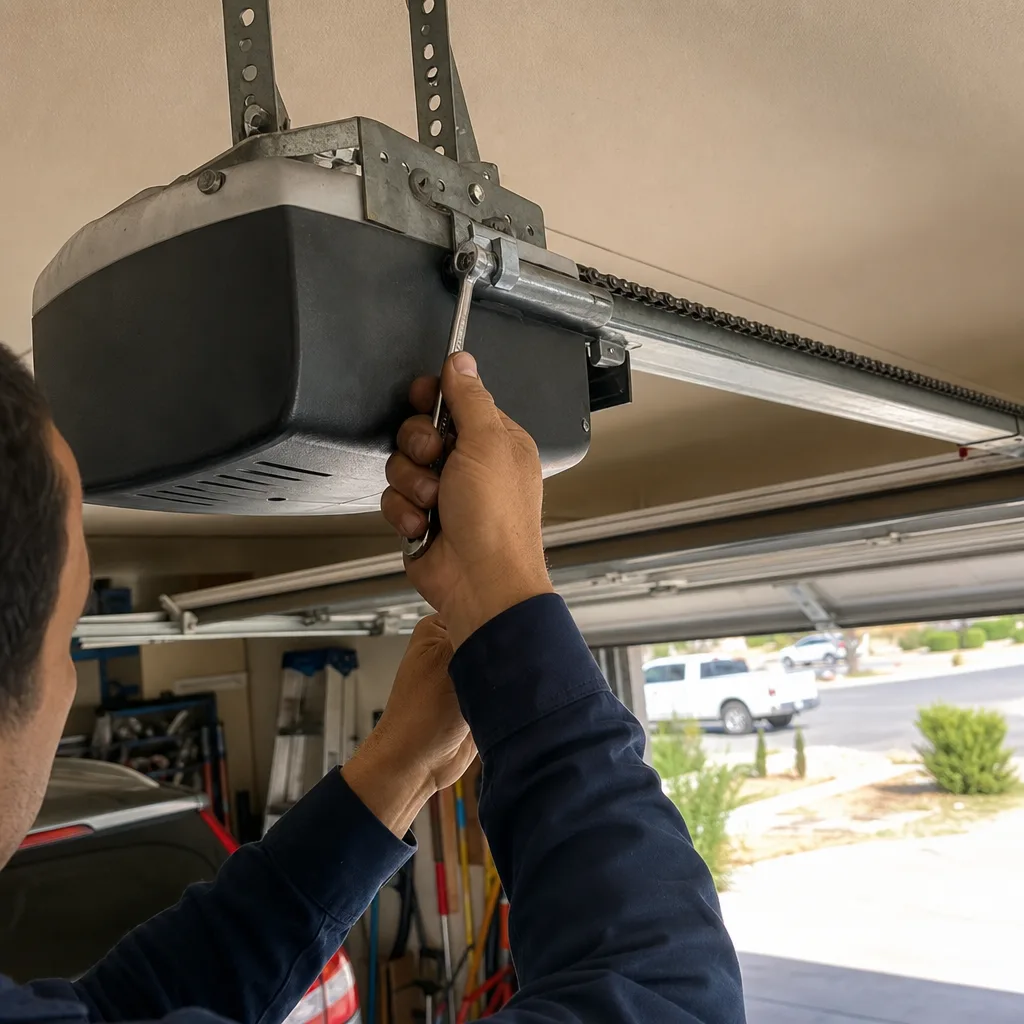
The logic board is the circuit board inside the opener motor unit that interprets signals from the wall button, remote, and safety sensors, then tells the motor what to do. When the logic board begins to fail, the symptoms are different from any mechanical component on the door itself. The motor may run. The gears may turn. But the door does not respond, or responds intermittently, or reverses mid-cycle for no reason.
The 30-day sequence for a logic board in failure typically looks like this:
- Day 30 to 14: The door occasionally fails to respond to the first press of the wall button. A second press works. Homeowners typically attribute this to a weak remote battery, but the wall button is hardwired and does not use a battery.
- Day 14 to 7: The door reverses after closing about one foot. The safety sensors are clean and aligned, but the board is misreading the sensor signal. This is a classic early logic board failure signature.
- Day 7 to 1: The opener light flashes in a diagnostic pattern after each cycle. The specific pattern varies by manufacturer. LiftMaster and Chamberlain use sequences of up and down arrows; Genie uses red and green LED combinations. The pattern is telling you the detected fault code, but the root cause is frequently the board itself.
- Day 1 to 0: The motor runs but the trolley carriage does not move. The board is sending power but not timing. The door is dead.
In Palmdale, we also see a specific seasonal factor-one reason Seasonal Garage Door Care for Palmdale: Year-Round Homeowner’s Guide matters: the high summer temperatures in the Antelope Valley can push an already marginal logic board past its thermal limit. The opener works in the morning, fails in the late afternoon heat, and works again after dusk. That intermittent heat-related failure is a board that is already at the edge.
For opener-specific diagnosis and repair, including which failure patterns mean replacement rather than repair, see Garage Door Opener Repair & Installation in Palmdale.
The 10-Second Manual Lift Test: Separating Balance, Track, and Opener Problems
The fastest way to identify what kind of problem you have is to take the opener out of the equation entirely. This test requires no tools and takes about ten seconds. It works because each type of failure presents differently when the motor is not involved.
Here is the procedure:
- Close the door fully.
- Pull the red emergency release cord hanging from the opener rail. This disconnects the door from the motor carriage.
- Lift the door manually to the halfway point, then let go.
Now read the result:
- The door stays at the halfway point without moving more than an inch either way: the spring balance is correct. The problem is in the opener, the tracks, or the rollers.
- The door drifts downward: the spring has lost tension. This is a spring problem, not a track or opener problem. It will get worse, and the door will eventually not hold at all.
- The door rises upward on its own: the spring is over-tensioned. This is less common but equally serious because it means the spring is working too hard and may fatigue early.
- The door moves easily but stops at a specific point with a scraping sound: you have a track bend or a damaged roller at that height. Look at the track at the exact point where the sound occurs.
- The door is extremely heavy from the moment you start lifting: the spring is already broken or fully unwound. Do not attempt to force the door open. The combined weight of a full section door is unmanageable, and cables under false tension can whip if a spring lets go.
We have used this exact test protocol on thousands of Palmdale service calls because it tells us in the first thirty seconds whether we are looking at a mechanical problem or an electrical one. You can do the same thing before you ever pick up the phone, and the result you describe to a technician over the phone will be more useful than “the door doesn’t work right.”
Palmdale-Specific Warning Signs: Sand, UV, and Wind
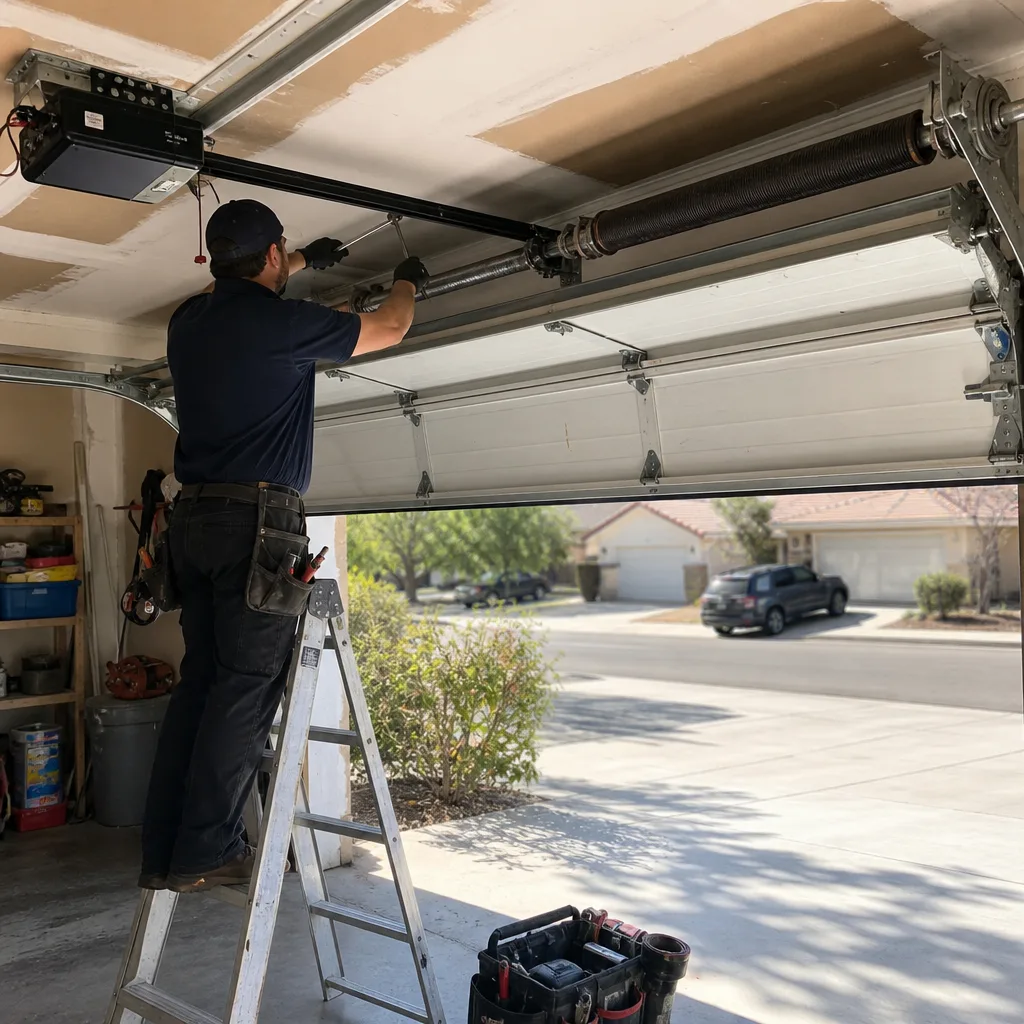
Every climate produces its own version of garage door aging. A guide written for Minneapolis or Seattle tells you about rust from road salt and corrosion from constant moisture. Those are not Palmdale’s problems. Our problems are abrasion, ultraviolet exposure, and wind shear.
Sand accumulation in the roller tracks: The fine dust that coats outdoor surfaces across the Antelope Valley works its way into vertical tracks. Over time, it forms a compacted grit layer at the bottom curve of the track that mimics the symptoms of bearing wear: the door scrapes, rattles, and shudders in specific spots. Homeowners frequently misdiagnose this as a roller failure. The differentiation is simple: a track packed with sand will show visible brown or tan residue inside the track channel. A roller failure will not. If your track looks like it has been dusted with fine desert sand, it has been. Clear it first, then reassess. If the noise returns within two weeks, it was not the sand; it was the bearings, and now you have the evidence.
UV-cracked panel seams: Palmdale records over 280 days of sunshine a year. UV radiation degrades the exterior surface of non-insulated steel doors, particularly along horizontal seams where panels meet. At first, the seams show hairline cracks in the paint, which is cosmetic. When those cracks widen enough to expose the substrate, water can enter the panel core during the rare but real Palmdale rain events, and the panel begins to delaminate from the inside. On doors that face west or southwest, the degradation is measurably faster. We see panel seams on ten-year-old west-facing doors in Palmdale that look like fifteen-year-old doors anywhere else.
Wind-resistant design stress: Palmdale is in a high-wind region. The local building code requires garage doors to meet wind-load ratings for their exposure category, and doors installed after the mid-2000s generally do. What the code does not require the homeowner to understand is that a wind-rated door under sustained loading flexes more at the center than a non-rated door. That flexing concentrates stress where the horizontal struts attach to the interior of the panels. The earliest warning sign is a specific sound: a creaking or popping from the door panels themselves, not the springs, when the wind gusts above about 25 miles per hour. Amarr and Wayne Dalton doors we service in Palmdale show this signature more often on uninsulated models because the single-skin panel has less internal structure to resist momentary flexing.
Safe to Monitor vs. Same-Week Service: A Plain Binary
Not every warning sign needs a technician this week. Some can be monitored for thirty days without consequence. Others are the same category of urgency as a tire losing pressure at highway speed. Here is the plain binary, based on what we tell Palmdale customers when they call and describe a symptom.
Safe to monitor:
- A faint squeal from the roller track that is intermittent and does not change month to month
- Cosmetic hairline cracks in the exterior paint at panel seams, as long as the substrate is not exposed
- An opener that hesitates for half a second when unprompted, once a week or less
- A door that is level and balanced but produces a single pop sound from the spring area in cold overnight temperatures
Same-week service:
- Any visible fraying or “fuzz” on a lift cable
- A door that drifts downward when released at the halfway point of the manual lift test
- A grinding sound that is consistent and repeatable at the same point in the door’s travel
- Visible gaps forming between coils of the torsion spring
- An opener that runs without moving the door, or reverses consistently at a specific point
- A door that shudders violently during operation, to the point where you can see the horizontal sections flexing
The principle is simple: anything that involves load-bearing components under tension or cables under load is same-week. Anything that is cosmetic or intermittent, and does not involve the door’s structural path, is safe to document and monitor for a defined period. When in doubt, photograph what you see and send it to a technician. We have had Palmdale customers who emailed a photo of a frayed cable and had a replacement scheduled before the door ever failed. That’s the entire point of this guide.
What to Photograph When You See a Warning Sign
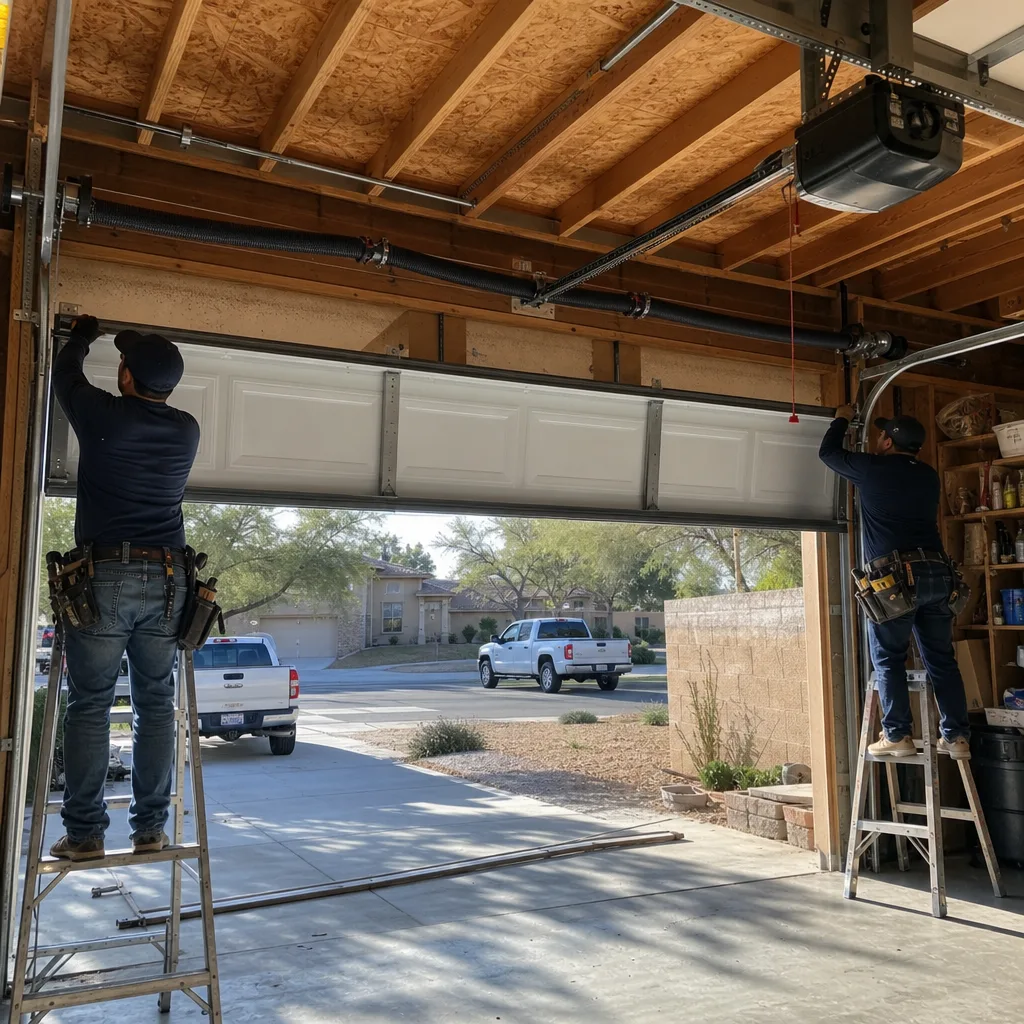
Your phone is the best diagnostic tool you already own. The goal here is not artistic merit. The goal is to create a documented record that serves three purposes: it gives a technician useful pre-arrival information, it gives you a baseline for tracking whether a symptom is getting worse, and if you are comparing estimates from multiple companies, it gives each estimator the same evidence to quote against.
Here is exactly what to capture, based on the symptom:
- Spring corrosion or coil separation: Stand on a ladder, not a chair. Frame the spring end-to-end. Use flash. The photo should show the entire spring, both winding cones, and the center bracket. If you see a gap between coils, take a second close-up at that point.
- Cable fraying: Take one photo from three feet away showing the cable in relation to the door and track, and one close-up at the frayed spot. The close-up is the one that shows the fuzzy strands; the wide shot is the one that shows where the failure is occurring.
- Track misalignment or sand accumulation: Stand inside the garage, looking down the track from the front of the garage toward the back. Photograph the track with the door fully open and again fully closed. The contrast shows bends and accumulated grit.
- Roller wear: The roller sits inside the track, so a useful photo requires the door in the open position where the horizontal track is visible. Frame the roller body against the track edge. A flattened wheel is visible as a flat spot on the roller’s circumference.
- Panel seam cracks: Shoot along the seam, not directly at it. The raking light from the side makes cracks visible that a straight-on shot will miss.
- Door imbalance: Take a photo with the door in the halfway position, showing the gap between the bottom seal and the floor on both sides. A tape measure in the frame helps. The measurement tells a technician more than the photo alone.
At Servo, this photo record is not the customer’s job to create: it is included on every visit because Clause 4 of The Haven Standard requires that you see the failed part before anyone quotes a replacement. But the customer’s own photos are what start the conversation, and a Palmdale homeowner who sends photos with their service request typically gets a more precise pre-visit diagnosis than one who does not.
Common Mistakes to Avoid
- Lubricating a failing spring to “quiet it down.” A spring that creaks is already fatigued. Lubricant will make the symptom quieter for a few days and delay the repair, which is the opposite of what you want. When a torsion spring’s coils are separating, no lubricant on earth restores its metal fatigue.
- Keeping the door operational with a frayed cable because “it still works.” Every cycle with a frayed cable adds load to the remaining strands. The failure when it comes will not be gradual; it will be sudden and the door will drop. The repair is cheaper than the damage.
- Assuming all opener problems are the remote battery or the safety sensors. A logic board in decline produces symptoms that mimic both, but a board failure does not fix itself. Replacing batteries and wiping sensor lenses is the first move, but if the symptom persists, the board is the next suspect.
- Ignoring a door that hangs slightly crooked because “it’s always been that way.” A door that hangs crooked by even half an inch at rest is telling you that the spring balance has shifted. It does not stabilize. It worsens.
- Using the manual emergency release as a permanent operating method. Disconnecting the opener and running the door by hand because the motor “started acting up” transfers the entire lifting effort to your body and masks the underlying mechanical problem. You will eventually drop the door, and a dropped door bends the track, the panels, or both.
- Waiting for the door to fail before checking anything. Every sequence in this guide runs four to eight weeks. The homeowners who read the signs and act in the window spend less, wait less, and are never trapped with a car stuck inside the garage. The homeowners who wait until the snap spend the most and wait the longest. In Palmdale, summertime garage door failures mean a car sitting in 110-degree heat, so the cost of waiting is not just financial.
When to Call a Professional
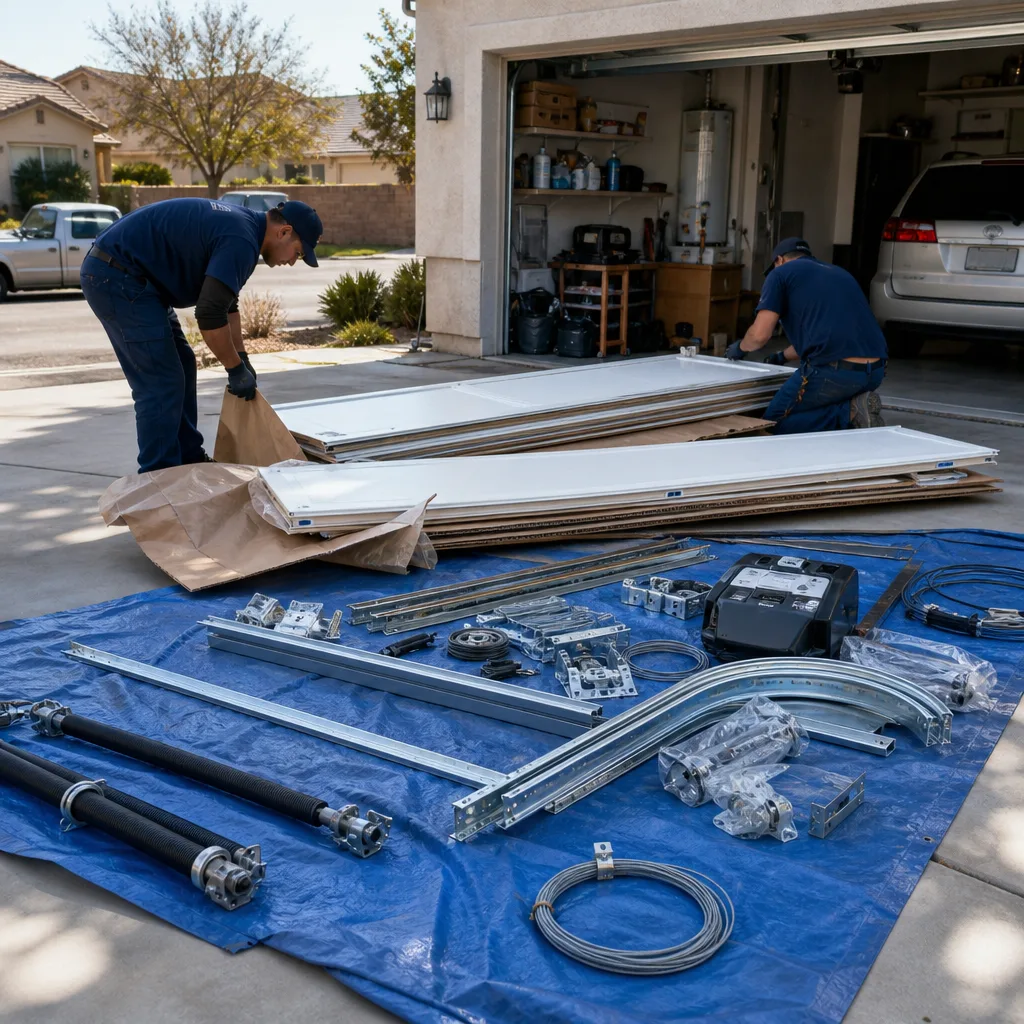
Call the same day you observe any of the same-week items listed above. Do not continue cycling the door to “confirm” what you already saw. Each additional cycle on a frayed cable, a separating spring, or a failing roller makes the eventual repair more extensive. If the door has already failed, leave it where it is. Do not attempt to lift a door with a snapped spring. The weight is concentrated and the cables are unloaded; forcing the door upward can cause the cables to slip off the drums and whip backwards. High-tension springs and cables genuinely demand a trained professional with the right winding tools and a respect for what the door weighs.
Servo Garage Doors Palmdale offers free estimates in Palmdale, and every job begins with a flat, written price and written scope before any work starts, per Clause 1 of The Haven Standard. Call (661) 449-2581 and a real person answers, 24/7, including emergencies. The technician arrives with a background check, a uniform, and a camera, and the photo record of what was found and what was done is yours when the visit concludes.
Frequently Asked Questions
A single torsion spring replacement in Palmdale typically runs $180 to $340 including parts and labor, with most jobs completed the same day. The price is quoted as a flat, written number before any work starts. Call (661) 449-2581 for a free estimate specific to your door.
Yes, a door can drop suddenly when a torsion spring snaps while the door is in motion, which is why the manual emergency release should never be used as a routine operating method and why any same-week warning sign should be addressed before the failure point. This is a genuine safety event, not a cosmetic nuisance.
A fraying cable shows fine steel hair fibers first, then visible strand separation, then a fuzzy appearance over several inches, and finally a visible kink or diameter reduction at the pulley contact point. If you see any fuzz on the cable, that is a same-week service item.
Pull the red emergency release cord, lift the door to the halfway point, and let go. If it stays, the spring tension is correct. If it drifts down, the spring is losing tension. If it rises, the spring is over-tensioned. This test takes ten seconds and requires no tools.
This is typically a heat-related logic board failure. The Antelope Valley’s summer temperatures push a marginal board past its thermal limit, and the opener fails during the hottest part of the day, then works again after cooling. It is a board in decline, not a remote problem.
No. The price is quoted as a flat, written number before any work begins, and the written scope specifies what is being replaced and why. Clause 1 of The Haven Standard exists precisely so the price on paper is the price on the invoice. If the technician finds something additional, that is a new written quote, not a revised invoice.
Yes. Service vehicles carry torsion springs across the common wire diameters, cables, rollers, hinges, and opener components, so most Palmdale repairs complete in a single visit. The photo record of the failed part is captured before the replacement is quoted, per Clause 4 of The Haven Standard.
The Bottom Line
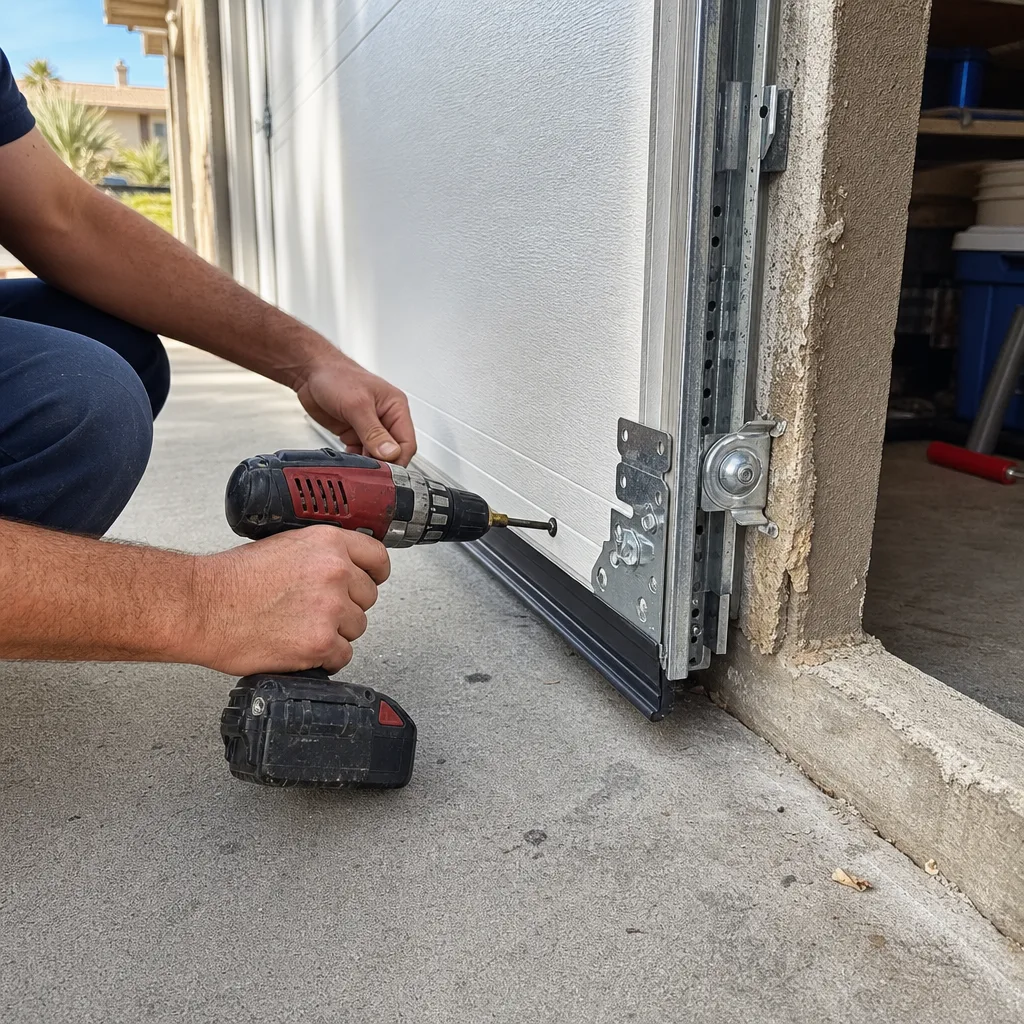
Garage door failures in Palmdale are predictable. The spring loses tension over weeks. The cable frays strand by strand. The roller bearing announces itself with a sound that changes pitch. The logic board fails in stages, often on the hottest afternoons. None of this is mysterious, and none of it requires heroic attention: it requires knowing what you are looking at and photographing what you see. The homeowners who act in the four-to-eight-week warning window fix their doors on their schedule, at a known price, without an emergency. The ones who wait until the snap pay more and wait longer, and in Palmdale’s summer, that wait happens in a car sitting under a hundred-degree sun. When the warning sign appears, document it, classify it using the plain binary in this guide, and call (661) 449-2581. For more guides & resources, visit our blog. A real person answers, the price is written before the work begins, and the documentation comes home with the technician’s name on it.
Written by Marcus Deller, Owner at Servo Garage Doors Palmdale, serving Palmdale since 2015.